

TWO-PHASE DENTAL IMPLANT
30 Years of Experience | 35,000+ Implants Placed | 99.7% Success Ra
Maximum Safety and Long-Term Stability
Two-phase dental implantation is one of the most secure and predictable methods of tooth replacement, executed in two distinct, sequential stages. This approach is particularly advantageous when the goal is a highly stable, natural-feeling restoration that prioritizes total risk management and exceptional longevity. By allowing the implant to fully integrate with the bone before any functional load is applied, this method ensures a foundation of unparalleled strength.
Key Characteristics of the Two-Phase Protocol
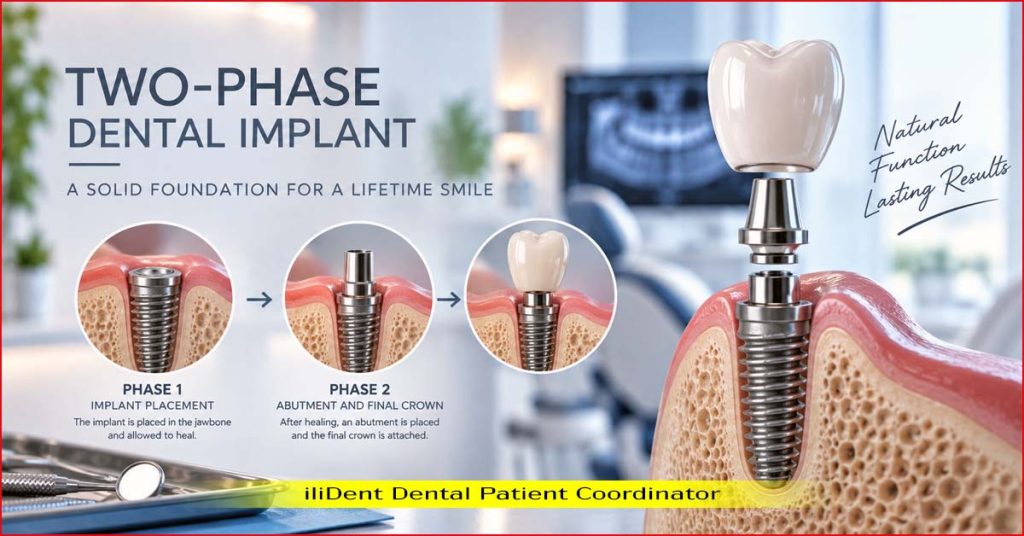
In a two-phase procedure, the placement of the implant and the attachment of the final restoration occur at different times. This allows for a gradual, biological fusion between the titanium and the jawbone.
This method is highly recommended if:
— The implant cannot be safely loaded immediately due to clinical factors.
— An extraction site was previously inflamed and requires time for full tissue regeneration.
— The surgeon advises a “submerged” or protected healing environment.
— Your general health or specific anatomical conditions favor a more cautious, gradual approach.
The Main Advantage: Predictable Excellence
While modern rapid protocols are excellent for many, the two-phase method remains the “gold standard” for complex cases where bone quality or volume requires a controlled, step-by-step recovery.
Maximum Structural Integrity: The restoration is only finalized once osseointegration is complete.
Versatility: Ideal for single tooth replacement or complex rehabilitations involving bone grafts or sinus lifts.
Peace of Mind: Provides the body with an undisturbed healing period, minimizing the risk of implant failure.
High-End Aesthetics: Results in a functional and aesthetic outcome that mirrors the look and feel of natural teeth.
The Treatment Journey
The two-phase process follows a structured timeline to ensure the most stable and aesthetic end result.
Phase 1: Implantation and Initial Healing
— Consultation & Planning: Comprehensive 3D diagnostics (CT/X-ray) and treatment design.
— Surgical Placement: The implant is placed into the jawbone under local anesthesia.
— Protected Integration: A 3–5 month period follows, during which the implant integrates with the bone structure. A temporary restoration is provided so you are never without teeth.
Phase 2: Final Restoration
— Verification: Clinical assessment and X-ray to confirm successful integration.
— Permanent Placement: The custom-crafted, high-strength porcelain or zirconium restoration is securely attached to the implant.
FULL MOUTH REHABILITATION WITH TWO-PHASE IMPLANTS
FAQ – Two-Phase Dental Implants
1. Is the procedure painful? — No. The procedure is performed under local anesthesia, ensuring a completely pain-free experience. Post-operative discomfort is typically minimal and easily managed.
2. When will I receive my permanent restoration? — The final restoration is placed after the osseointegration process is complete, which usually takes between 3 and 5 months depending on individual healing.
3. How long is the initial recovery period? — Soft tissue healing typically takes 1–2 weeks, after which you can resume normal daily activities while the bone integration continues.
4. Can this be used if I have low bone density? — Two-phase implants require a certain quality and volume of bone. If bone density is insufficient, bone grafting or a one-phase implant system may be recommended.
5. How does this differ from the one-phase solution? — The two-phase method involves two separate stages to allow for undisturbed healing, whereas the one-phase system is designed for immediate loading in a single surgical step.
A Proven Path to Lasting Results
Choosing a two-phase implant means choosing the most cautious and secure route to a permanent dental transformation. It allows for a natural healing process, ensuring your final restoration remains stable and functional for decades to come.