
DENTAL IMPLANT RESTORATION: SAFE, COMFORTABLE, AND UNDER ANESTHESIA
Our specialty is subperiosteal implantation for full-mouth rehabilitation using a fundamentally different approach to conventional implant dentistry.
Treatment options include:
— One-phase implant restoration
— Two-phase implant restoration
— All-on-4 restoration with four implants
— All-on-6 restoration with six implants
— Subperiosteal implantation
Full dental restoration with implants (oral rehabilitation) can be performed:
— On the upper jaw only
— On the lower jaw only
— On both jaws
Upon request, we will also include the cost of anesthesia in the personalized treatment plan and quote.
Dental restoration isn’t just for full dentures — even a one missing tooth or a few teeth can be replaced. In these cases, we prepare your treatment plan and quote based on a personal consultation or a recent panoramic X-ray you provide.
The services of the iliDent Dental Patient Coordinator are completely free of charge for patients!
IMPLANT-SUPPORTED RESTORATION UNDER SEDATION, STEP BY STEP
Our implant placement package under anesthesia includes the following steps:
— Personal consultation with an oral surgeon specialized in implantology.
— CT scan and panoramic X-ray.
— Comprehensive oral examination, with special attention to bone condition.
— Anesthesia administered by an external anesthesiology team.
— Extraction of teeth unsuitable for dental treatment.
— Preparation of the required number of dental implants for placement.
— Placement of One-phase implants in the upper jaw.
— Fabrication of a long-term temporary denture for the upper jaw.
— Follow-up checkups as needed.
— Personal consultation with the oral surgeon who will perform the implant placement.
— Panoramic X-ray.
— Thorough oral examination, with special attention to the condition of the implants.
— Preparation of the permanent porcelain denture on the upper jaw.
— Required number of control examinations.
- Fast completion
- Only one surgical procedure required
- More affordable than two-phase implant restoration
- Suitable even in cases of bone deficiency.
— Personal consultation with an oral surgeon specialized in implantology.
— CT scan and panoramic X-ray.
— Comprehensive oral examination, with special attention to bone condition.
— Anesthesia administered by an external anesthesiology team.
— Extraction of teeth unsuitable for dental treatment.
— Preparation of the required number of dental implants for placement.
— Placement of One-phase implants in the lower jaw.
— Fabrication of a long-term temporary denture for the lower jaw.
— Follow-up checkups as needed.
— Personal consultation with the oral surgeon who will perform the implant placement.
— Panoramic X-ray.
— Thorough oral examination, with special attention to the condition of the implanted implants.
— Preparation of the permanent porcelain denture on the lower jaw.
— Required number of control examinations.
- Fast completion
- Only one surgical procedure required
- More affordable than two-phase implant restoration
- Suitable even in cases of bone deficiency.
DENTURE #2 FULL MOUTH REHABILITATION - Upper & Lower Jaw
— Personal consultation with the oral surgeon who will perform the implant placement.
— CT scan and panoramic X-ray.
— Comprehensive oral examination, with special attention to bone condition.
— Anesthesia administered by an external anesthesiology team.
— Extraction of teeth unsuitable for dental treatment.
— Preparation of the required number of dental implants for placement.
— Placement of One-phase implants in the upper and lower jaw.
— Fabrication of a long-term temporary denture for the upper and lower jaw.
— Follow-up checkups as needed.Comprehensive oral examination, with special attention to bone condition.
— Personal consultation with the oral surgeon who will perform the implant implantation.
— Panoramic X-ray.
— Thorough oral examination, with special attention to the condition of the implants.
— Preparation of the permanent porcelain denture on the upper and lower jaw.
— Required number of control examinations.
- Fast completion.
- Only one surgical procedure required.
- More affordable than two-phase implant restoration.
- Suitable even in cases of bone deficiency.
DENTURE #3 ALL-ON-4 DENTAL RESTORATION – FULL MOUTH REHABILITATION IN THREE STEPS
The All-on-4 implant-supported restoration was developed by Nobel Biocare. The concept involves placing four implants per jaw, which support a full fixed denture. Implant placement can be:
— on the upper jaw only
— on the lower jaw only
— or on both jaws
The treatment is completed in three consecutive steps, typically over 20 days.
- Consultation with an oral surgeon specialized in implantology
- Anesthesia if requested by the patient
- Extraction of teeth unsuitable for restoration
- Preparation for implant placement
- Assessment of implant condition
- Suture removal
- Impression for the long-term temporary denture
- Bonding of the temporary denture
- The denture is fixed and non-removable by the patient
- Requires fewer implants, so it costs less than other solutions.
- Fast procedure, usually no bone grafting needed.
- Smaller intervention, faster recovery.
- Patients with complete tooth loss
- When remaining teeth are unsuitable for further treatment
- Those seeking a stable, long-term alternative to removable dentures.
If you are interested in All-on-4 denture, please request a quote. We can only provide an online quote based on a panoramic X-ray taken with in the 3 months.
DENTURE #4 ALL-ON-6 DENTAL RESTORATION – FULL MOUTH REHABILITATION IN THREE STEPS
Dental implant-based complete denture
The All-on-6 implant-supported restoration was developed by Nobel Biocare. The concept involves placing six implants per jaw, which support a full fixed denture.
Implant placement can be:
— on the upper jaw only
— on the lower jaw only
— or on both jaws
The treatment is completed in three consecutive steps, typically over 20 days.
Step 1 – Preparation and Implant Placement
— Consultation with an oral surgeon specialized in implantology
— Anesthesia if requested by the patient
— Extraction of teeth unsuitable for restoration
— Preparation for implant placement
Step 2 – Checkup and Impression (approx. 7 days later)
— Assessment of implant condition
— Suture removal
— Impression for the temporary denture
Step 3 – Temporary Denture Placement (approx. 10–12 days later)
— Bonding of the temporary denture
— The denture is fixed and non-removable by the patient.
— Enhanced stability with six implants
— Fast procedure, usually no bone grafting needed
— Minimally invasive, faster healing.
— Patients with complete tooth loss
— When remaining teeth are unsuitable for further treatment
— Those seeking a stable, long-term alternative to removable dentures.
If you are interested in All-on-6 denture, please request a quote. We can only provide an online quote based on a panoramic X-ray taken no older than 3 months.
DENTURE #5 SUBPERIOSTEAL IMPLANTATION
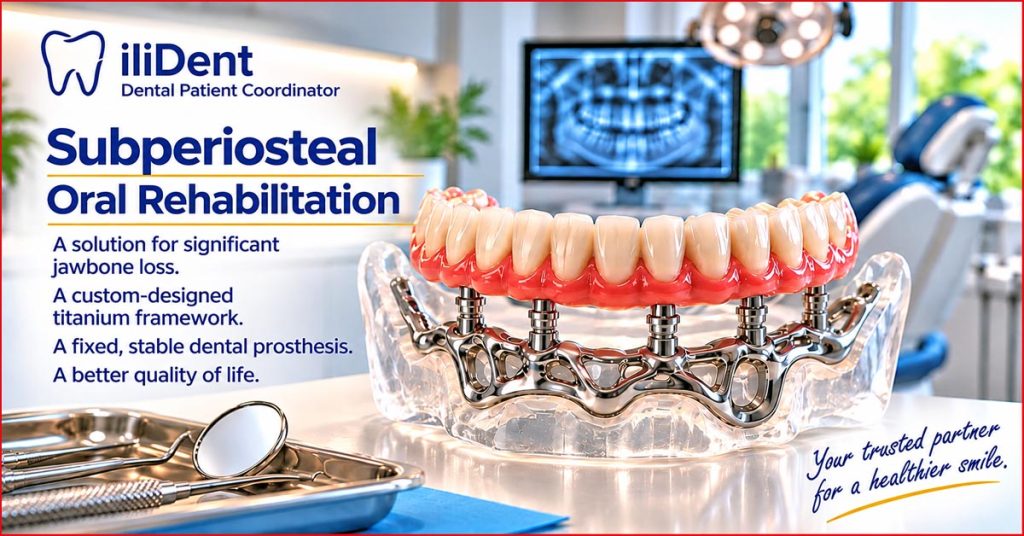
Subperiosteal implantation is an innovative dental restoration technology that can provide a solution for creating implant-supported fixed dentures in cases of severe bone loss. The essence of this unique, revolutionary technology is that the specialized implants are anchored to a custom-designed and custom-fabricated titanium framework secured directly onto the jawbone.
The titanium framework is individually designed to match each patient’s anatomical characteristics. 3D CBCT imaging is required for treatment planning.
Subperiosteal oral rehabilitation can involve:
— One-quarter of a jaw (upper left, upper right, lower left, or lower right)
— The entire upper or lower jaw
— Both the entire upper and lower jaw
The first phase of treatment consists of two consecutive appointments.
FIRST TREATMENT PHASE
Consultation, assessment, and preparation of a treatment plan and cost estimate
Appointment 1 — Consultation, assessment, and preparation of a treatment plan and cost estimate
During the initial consultation with the implantologist, the following steps take place:
— Review of the patient’s medical history and discussion of their needs and expectations.
— Comprehensive oral examination based on 3D CBCT imaging.
— If the patient is interested in subperiosteal dental rehabilitation, a treatment plan and cost estimate will be prepared.
— The patient will also receive information about the possibility of treatment under general anesthesia and the conditions involved.
Appointment 2 — Surgical procedure and placement of a long-term temporary denture
After the patient accepts the cost estimate and pays the required deposit, the custom-made subperiosteal titanium framework components are manufactured using precision CAD/CAM technology. The timing of the SECOND TREATMENT PHASE depends on the manufacturing time, which is generally 1–2 weeks.
The surgery is usually performed under general anesthesia. (The cost of general anesthesia is included in the package price!)
The surgical procedure includes:
— Exposure of the surgical site.
— Placement and fixation of the individually manufactured titanium subperiosteal components.
— Attachment of the required number of specialized implants to the subperiosteal framework.
After a healing period of 1–2 weeks, the long-term temporary denture is made and secured in place.
SECOND TREATMENT PHASE
Final Dental Prosthesis
Treatment steps:
— A thorough examination of the oral cavity based on 3D CBCT imaging.
— Taking impressions for the final dental prosthesis.
— Fabrication of the final dental prosthesis.
— Securing the final titanium-framework zirconia prosthesis in place.
Follow-up Care and Maintenance
To support long-term success, follow-up examinations are recommended every six months.
Why might this treatment be a suitable option?
— It may be used even in cases of significant jawbone loss.
— The framework can be designed with exceptional precision to match the patient’s individual anatomy.
— In certain cases, it may offer an alternative to treatments involving extensive bone grafting.
— It may make fixed dental prosthetic rehabilitation possible.
How does it differ from single-stage implant-based oral rehabilitation?
— One-phase implants are placed in the available jawbone. Thanks to their specialized design, they can often be used in cases where conventional two-stage implants may no longer be an optimal solution.
— Subperiosteal implants are not placed inside the jawbone. Instead, they are attached to a custom-made titanium framework that rests on the surface of the bone, beneath the gum tissue.
— In One-phase implant-based oral rehabilitation, stability is provided by the implants’ anchorage within the jawbone.
— The stability of the subperiosteal system is primarily achieved through its precise fit to the patient’s anatomy and multiple points of fixation to the bone.
— Both treatment options may make fixed dental prosthetic rehabilitation possible for patients with severely atrophied jawbones. However, the most appropriate treatment must always be determined based on the patient’s specific anatomy, bone quality, and available surgical options.
— When the available bone structure allows, single-stage implant-based rehabilitation may generally involve a simpler treatment process. Subperiosteal implantation is primarily recommended in cases where the amount of available bone or its anatomical characteristics limit the use of other implant-based solutions.
Do you have questions about subperiosteal oral rehabilitation? Contact us.
FINAL IMPLANT-SUPPORTED DENTURES
Zirconium Denture
Zirconia restorations are made using advanced CAD/CAM technology, ensuring maximum precision and durability. The denture is milled from a one solid block, making it highly resistant and less prone to damage.
Key Benefits:
— Outstanding esthetics – no porcelain layering required
— Gradual hardness from the inner core outward, mimicking natural tooth structure
— Ideal for patients prone to teeth grinding (bruxism)
— Exceptional stability, wear resistance, and long lifespan
— Fast and efficient manufacturing process
Metal-ceramic denture
If zirconia is not suitable, metal-ceramic restorations offer a reliable alternative. They are made from a special nickel-free cobalt-chromium alloy
Key Benefits:
— Durable, long-term solution for full-mouth restoration
— Quick fabrication
— More cost-effective than zirconia
— Excellent load-bearing capacity
— Suitable for full-arch dentures
— Backed by decades of clinical experience
— Nickel-free composition reduces the risk of allergic reactions.
WHY CHOOSE US?
Reliability You Can Count On
We don’t just promise quality — we guarantee it. Our double guarantee provides added protection for both the implants and the professional work..
Outstanding Professional Expertise
With our in-house dental lab, decades of experience, and specialized expertise in implant placement, we provide high-quality care at every stage of treatment.
Pain-Free Treatment, Every Step of the Way
Whether it’s a routine checkup or full-mouth rehabilitation, pain-free care and exceptional value are among our core principles.
Patient Satisfaction
The greatest recognition we receive is the trust and satisfaction of our patients
FULL-MOUTH REHABILITATION WITH DENTAL IMPLANTS UNDER ANESTHESIA
Want a full set of teeth with dental implants but afraid of the procedure? We offer the perfect solution: implant placement under anesthesia, performed safely by certified anesthesiology professionals. Your treatment is performed by certified anesthesiology professionals, ensuring a calm, pain-free experience from start to finish.
WHY IS A LONG-TERM TEMPORARY DENTURE NECESSARY?
During implant-supported oral rehabilitation, tooth extraction and implant placement put stress on the gums, which may temporarily swell and change shape. At this stage, we take impressions for the long-term temporary denture — one reason why the final denture is not made immediately.
Another reason is that a heavy porcelain denture would place too much pressure on the freshly placed implants, which have not yet fully integrated with the bone. That’s why we provide a lighter, acrylic-based temporary denture, which is aesthetic, stable, and offers proper chewing and biting function during the healing period.
Inflammation typically subsides within a few days, and the gums settle. However, full osseointegration of the implants takes 4–6 months. Important: the cost of the final denture is not included in the implant placement package.
The long-term temporary denture should be replaced with a final denture after about six months. By then, we can confirm whether the implants are securely anchored in the bone. If everything looks good, the final denture — metal-ceramic or zirconia — can be fabricated. The choice is made during a personal consultation with your specialist.
Full-arch implant restoration may involve:
— One-phase implants
— two-phase implants
— All-on-4 technology
— All-on-6 technology
The best solution for your case is determined during a personal consultation.
Dental implant-based oral rehabilitation with complete dentures is possible with One-Phase or Two-Phase implants, or All-on-4 and All-on-6 procedures. Which solution is best for you? We can decide in a personal consultation. Request an appointment for a free, no-obligation personal consultation.