SUBPERIOSTEAL IMPLANTATION
Subperiosteal implants may offer an alternative for patients with significant jawbone loss, potentially making full dental arch rehabilitation possible even when conventional dental implants cannot be used.
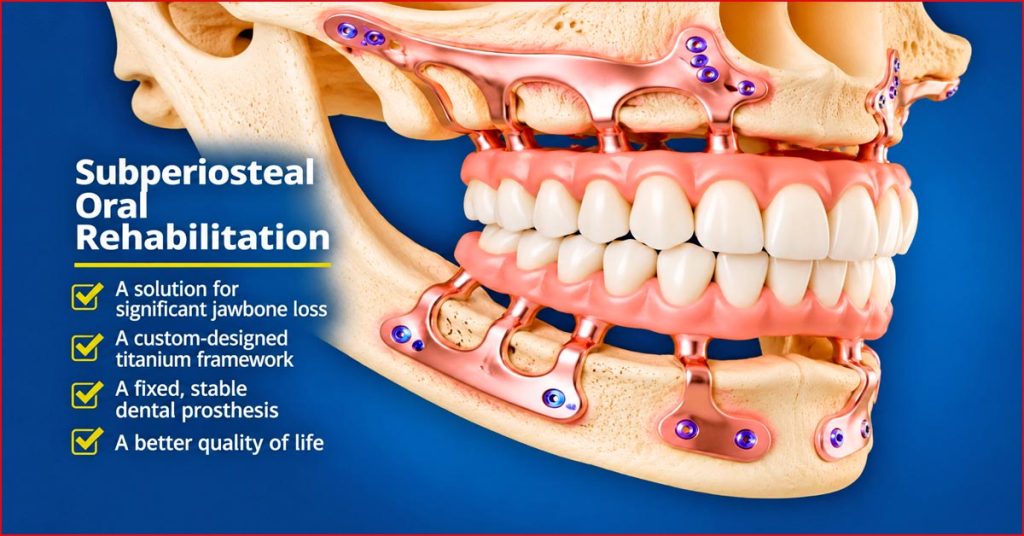
Traditional dental implants are placed into the jawbone. In subperiosteal oral rehabilitation, by contrast, a custom-designed titanium framework component is placed on the surface of the jawbone, beneath the periosteum, and tailored to the patient’s individual anatomical characteristics. The titanium framework serves as the base for the specialized implants, which are attached to it and support the dental prosthesis.
The purpose of this customized design is to ensure that the structure fits the anatomical contours of the patient’s jawbone precisely. The suitability of the treatment must always be determined through a detailed specialist examination and an individualized treatment plan.
What Problems May Subperiosteal Implantation Help Address?
Following tooth loss, the jawbone may gradually undergo significant resorption. As a result, there may be insufficient bone of adequate quality and/or quantity for the placement of conventional dental implants, or treatment may only be possible with extensive bone grafting or other additional procedures.
For patients with severe bone loss, conventional dental implants may not be a suitable option. Subperiosteal implants may provide an alternative treatment approach in carefully selected cases.
Subperiosteal implantation may offer an alternative in certain cases, particularly in the following situations:
— Significant jawbone loss, when the quality of the bone makes the safe placement of conventional dental implants difficult or impossible.
— Insufficient bone volume, when there is not enough available bone to support conventional implant placement.
— Unfavorable anatomical characteristics, when conventional implant treatment options are limited or treatment may require significant additional procedures.
How Is a Custom-Designed Subperiosteal Titanium Framework Created?
Digital planning and individualized design are important elements of modern subperiosteal implantation. The goal is to design a subperiosteal titanium framework that precisely matches the specific shape and anatomical characteristics of the patient’s jawbone. The planning process is based on appropriate imaging examinations and the anatomical information obtained from them. This information makes it possible to design a customized subperiosteal titanium framework that fits the jawbone and whose design also determines the subsequent surgical procedure and placement of the dental prosthesis.
Because of its individualized design and manufacturing process, the subperiosteal titanium framework is tailored to each patient’s anatomical characteristics.
HOW IS SUBPERIOSTEAL IMPLANTATION PERFORMED?
Subperiosteal implantation is a surgical procedure that requires individualized planning and careful preparation. The purpose of the treatment is to provide a subperiosteal titanium framework tailored to the patient’s anatomical characteristics, which serves as a base for the specialized implants and the dental prosthesis attached to them. The treatment may involve several successive steps, with the exact process determined by the individual treatment plan.
Assessment and Treatment Planning
The first step is a specialist examination of the oral cavity, jawbone, and available dental prosthetic options. The implantologist assesses the extent of bone loss, the anatomical conditions, the patient’s general health, and any factors that may affect the safety and expected outcome of the procedure. Based on these examinations, it can be determined whether subperiosteal implant-based oral rehabilitation may be an appropriate solution for the patient.
Digital Planning and Fabrication of the Subperiosteal Titanium Framework
Based on anatomical data obtained from appropriate imaging examinations, a subperiosteal titanium framework component is designed to fit the patient’s jawbone with exceptional precision. The purpose of this customized design is to ensure that the framework fits precisely against the surface of the jawbone and provides a suitable base for securing the planned dental prosthesis. Manufacturing is carried out according to the approved individual design.
Surgical Procedure
The planned subperiosteal titanium framework is placed on the surface of the jawbone, beneath the periosteum, during a surgical procedure and secured according to the requirements of the system being used. The specialized implants are then attached to the titanium framework. The surgical technique, method of fixation, and other details of the procedure depend on the system used and the patient’s individual anatomical characteristics.
What Type of Dental Prosthesis Can Be Made Using Subperiosteal Implantation?
The goal of subperiosteal implant-based oral rehabilitation is to replace missing teeth and restore chewing function with a fixed dental prosthesis. This treatment may be particularly relevant in cases where the patient has no remaining teeth suitable for prosthetic treatment and conventional dental implants cannot be used because of significant bone loss.
The design of the dental prosthesis is influenced by the anatomical characteristics of the jawbone, the position of the teeth to be replaced, the requirements for restoring chewing function, and the design of the planned structure. The anatomical characteristics of the upper and lower jaws differ, so the titanium framework and the associated dental prosthesis must always be designed individually. The appropriate solution is selected by coordinating surgical planning with prosthetic treatment planning.
Advantages of Subperiosteal Implantation
Modern, customized subperiosteal implantation may offer an alternative for patients with significant jawbone loss.
Potential Benefits of the Method:
— Customized Design. The subperiosteal titanium framework is designed and manufactured to match the anatomical characteristics of the patient’s jawbone.
— An Alternative Treatment Option for Significant Bone Loss. For suitable patients, it may make implant-supported fixed dental prosthetic rehabilitation possible even when conventional implant treatment cannot be used.
— The Possibility of Avoiding Extensive Bone Grafting. It may make it possible to avoid the extensive bone grafting required for conventional implant treatment. However, this is not possible for every patient.
— Digital Planning and Custom Manufacturing. Planning based on imaging examinations and individual anatomical data helps create a titanium framework component tailored to the patient’s specific anatomical characteristics.
It is important to emphasize that the potential benefits listed above are not guarantees that apply to every patient. The suitability and expected outcome of treatment are influenced by several factors, including the patient’s condition, planning, surgical execution, prosthetic design, and follow-up care.
What Are the Limitations and Risks?
Subperiosteal implantation is a complex surgical and prosthetic treatment that, in addition to its potential benefits, also has risks and limitations. These factors must be considered when planning treatment, along with the patient’s individual characteristics and the expected prosthetic outcome.
Possible Complications:
— Wound-Healing Problems. Wound opening or delayed healing.
— Soft-Tissue Inflammation and Infection. The tissues surrounding the titanium framework component may become inflamed, sometimes accompanied by discharge or pain.
— Partial Exposure of the Titanium Framework. Retraction of the overlying soft tissues or wound opening may cause part of the framework to become visible.
— Mechanical and Prosthetic Problems. In rare cases, loosening of the fixation or damage to parts of the dental prosthesis may occur.
Clinical studies on modern, digitally planned subperiosteal implant-based oral rehabilitation report encouraging results. However, the frequency of complications may vary considerably among the cases studied and the systems used.
Proper patient selection, careful planning, professional surgical and prosthetic execution, adequate cleanability of the dental prosthesis, and regular follow-up examinations are particularly important for long-term maintenance. The treating doctor determines the necessary checkups and home oral-care instructions based on the patient’s individual risks.
Who May Be a Suitable Candidate for Subperiosteal Implantation?
Subperiosteal implant-based oral rehabilitation may primarily be considered for patients with significant jawbone loss in whom conventional dental implant placement, including single-stage implants, is not possible. The goal of the treatment is to offer an alternative for implant-supported dental prosthetic rehabilitation in appropriately selected cases.
Suitability for treatment cannot be determined solely by the quantity or quality of the available bone. The specialist must also consider the patient’s general health, the condition of the oral cavity and soft tissues, the ability to maintain proper oral hygiene, the prosthetic goals, and possible alternative treatments.
A detailed specialist examination and an individualized treatment plan are always required to determine the most appropriate solution. This assessment considers the potential benefits and risks of subperiosteal implantation, as well as the requirements for long-term maintenance, to determine whether it is an appropriate option for the individual patient.
FREQUENTLY ASKED QUESTIONS ABOUT SUBPERIOSTEAL IMPLANTATION
How Does Subperiosteal Implantation Differ from Conventional Implantation?
Conventional dental implants are placed into the jawbone. In subperiosteal implantation, by contrast, a custom-designed titanium framework is placed on the surface of the jawbone, beneath the periosteum. Specialized implants are attached to the titanium framework, and these implants provide the stability needed to support the dental prosthesis.
Who May Benefit from Subperiosteal Implantation?
It is primarily recommended for patients with significant bone loss that makes conventional implant treatment impossible or would require extensive bone grafting. Suitability must always be assessed through an individual specialist examination.
Can Bone Grafting Always Be Avoided?
No. In appropriately selected cases, subperiosteal implantation may offer the possibility of avoiding procedures involving extensive bone grafting, but this cannot be guaranteed for every patient. The appropriate treatment option depends on the patient’s anatomical characteristics and individual treatment plan.
Why Is a Custom-Designed Titanium Framework Made for Every Patient?
The shape and anatomical characteristics of the jawbone vary from person to person. During digital planning, the subperiosteal titanium framework is designed to match these individual characteristics. The framework serves as the base for the dental prosthesis and provides support for the specialized implants attached to it.
How Is the Subperiosteal Titanium Framework Placed?
The procedure is preceded by a specialist examination and digital planning. The custom-designed titanium framework is surgically placed on the surface of the jawbone, beneath the periosteum, and secured according to the system being used. The necessary specialized implants are then attached to it. The exact surgical technique and procedural details are determined by the individual treatment plan.
What Type of Dental Prosthesis Is Made with Subperiosteal Implantation?
The goal of the treatment is to provide a fixed dental prosthesis supported by implants. The type, material, and design of the prosthesis are determined by the patient’s anatomical characteristics, prosthetic goals, and individual treatment plan. Depending on the solution used, the prosthesis is fixed and cannot be removed by the patient.
Can the Method Be Used on Both the Upper and Lower Jaw?
Subperiosteal implant-based oral rehabilitation may be used for the following areas:
— One quadrant of the jaw (upper left, upper right, lower left, or lower right)
— The entire upper or lower jaw
— Both the entire upper and lower jaw
Suitability is determined through a specialist examination.
What Are the Potential Benefits of Subperiosteal Implantation?
It may offer an alternative for patients with significant bone loss. The custom-designed titanium framework component is tailored to the patient’s anatomical characteristics and may make it possible to avoid extensive bone grafting. The potential benefits and outcomes may vary from patient to patient.
What Risks May Be Associated with Subperiosteal Implantation?
Potential risks of the treatment include:
— Wound-healing problems
— Soft-tissue inflammation
— Infection
— Partial exposure of the titanium framework
— Mechanical or technical problems involving the dental prosthesis
The extent of these risks also depends on the patient’s individual condition and the circumstances of the treatment. Before the procedure, it is important to review the potential benefits and risks with the specialist.
How Long Do the Results of Subperiosteal Implantation Last?
Studies on modern, custom-designed subperiosteal implantation report encouraging results, but long-term data are still limited. Therefore, no lifespan or success guarantee can be given that applies to every patient. Long-term results depend on precise planning, an implantologist with the appropriate expertise and experience, and the professional, precise execution of the procedure.
How Should a Fixed Dental Prosthesis Be Cleaned?
Regular and thorough cleaning of a fixed dental prosthesis is essential. The cleaning method depends on the design of the prosthesis and how accessible its individual parts are. The treating doctor should provide personalized instructions on the appropriate oral hygiene tools and techniques to ensure that the prosthesis and surrounding tissues can be kept clean.
How Often Are Follow-Up Examinations Necessary?
The frequency of follow-up examinations is determined by the treating doctor based on the patient’s individual condition, healing progress, and the condition of the tissues surrounding the dental prosthesis. During these examinations, the stability of the prosthesis, the condition of the surrounding soft tissues, and any early signs of complications can be checked. Regular monitoring is an important part of long-term maintenance.
What Signs Should Prompt You to Contact Your Treating Doctor as Soon as Possible?
If you experience pain, swelling, recurrent bleeding, inflammation, discharge, loosening of the dental prosthesis, or exposure of the titanium framework, contact your treating doctor as soon as possible. These symptoms require examination, so you should not wait until your next scheduled follow-up appointment.
How Can I Find Out Whether This Oral Rehabilitation Treatment Is Right for Me?
A detailed specialist examination and an individualized treatment plan are required. The specialist considers the anatomical characteristics of the jawbone, the condition and quantity of the bone tissue, the patient’s general health, the condition of the oral cavity, and the patient’s prosthetic goals. Based on these factors, it can be determined whether subperiosteal implantation is an appropriate option or whether another treatment approach is recommended.
If your questions have not been answered or you are interested in dental prosthetic treatment based on subperiosteal implantation, please contact us.