
All‑on‑4 Full Mouth Rehabilitation: A Case Study from the First Visit to the Final Prosthesis
Introduction
Full mouth rehabilitation with All‑on‑4 technology offers an effective solution for patients with severely damaged dentition, bone loss, and functional limitations. This case study presents the story of a man who avoided dental treatment for more than a decade, during which progressive periodontal disease and bone resorption made chewing, speaking, and social interaction increasingly difficult. His case demonstrates how accurate diagnostics and modern implantology can restore a full arch of teeth even in severely compromised conditions.
Patient Information (Anonymized)
The patient is a 62‑year‑old man who previously led an active lifestyle but gradually withdrew from social activities due to the condition of his teeth. Advanced periodontal disease, multiple missing teeth, and the near‑complete loss of chewing function forced him to consume only soft foods. He is a non‑smoker, has no chronic illnesses, but avoided dental care for more than ten years due to dental anxiety. His family history includes periodontal disease and early tooth loss.
Diagnosis
Clinical examination revealed only a few remaining teeth in the upper arch, all severely mobile and no longer functional. The gums were inflamed and prone to bleeding, and the bone structure had significantly receded. The patient’s facial profile had collapsed, further affecting his self‑confidence.
Diagnostic imaging findings
— Panoramic X‑ray showed extensive bone loss in the posterior maxilla.
— CBCT imaging revealed enlarged maxillary sinuses and insufficient bone height for conventional implants.
— Adequate anterior bone width allowed the All‑on‑4 protocol to be applied.
Final diagnosis:
— Advanced periodontal disease.
— Severe bone resorption.
— Functional and aesthetic insufficiency.
— Psychological distress
Treatment Plan
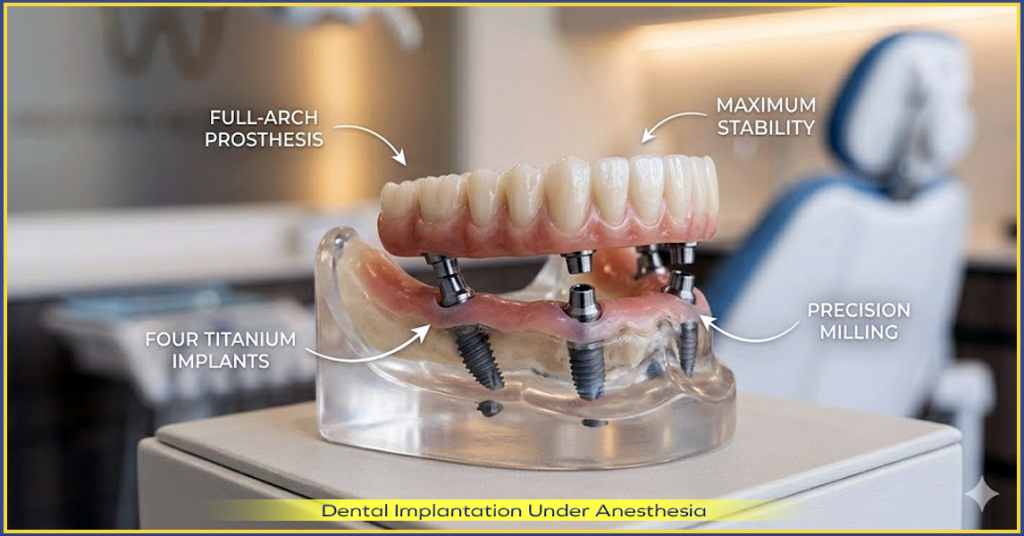
The implantologist recommended full mouth rehabilitation using the All‑on‑4 protocol, which best matched the patient’s anatomical conditions and personal goals.
Reasons for choosing All‑on‑4:
— Adequate anterior bone allowed stable placement of four implants.
— Angled posterior implants avoided the sinus area, eliminating the need for bone grafting.
— The patient could receive an immediately loaded temporary prosthesis.
— The method is predictable and minimally invasive.
The patient’s goal was to regain a stable, natural‑looking set of teeth that restored chewing function and confidence. He accepted the treatment plan.
A traditional two‑stage implant procedure with sinus lift and lateral bone augmentation was considered, but the patient’s bone loss would have required multiple surgeries over 9–12 months. He did not wish to undergo such a lengthy process.
Compared to this, the All‑on‑4 solution: — Required only one surgical procedure — Provided an immediately loaded fixed temporary prosthesis — Avoided bone grafting — Offered rapid psychological relief
Before surgery, the patient received a digitally designed wax‑up of the planned temporary prosthesis, allowing him to visualize the expected aesthetic outcome and reducing anxiety.
Surgical Procedure
The procedure was performed under local anesthesia. The patient remained calm throughout, having been thoroughly informed about each step.
Surgical steps:
— Extraction of all remaining non‑restorable teeth in the upper arch.
— Removal of inflamed tissue and cleaning of the bone surface.
— Placement of four implants according to the All‑on‑4 protocol.
— Verification of primary stability.
— Fixation of the long‑term temporary prosthesis on the same day
The patient left the clinic with a stable temporary prosthesis, allowing cautious chewing and immediate aesthetic improvement.
Results and Follow‑Up
During the first few days after surgery, the patient experienced mild swelling and sensitivity. The soft tissues healed well during the first 1–2 weeks, and inflammation resolved.
On postoperative day 7, the mandatory follow‑up took place. The implantologist:
— Checked implant stability.
— Removed sutures.
— Took impressions for the final prosthesis
Healing continued over the next 10–12 days, with gum inflammation subsiding and the oral cavity showing a healthy condition.
The final prosthesis was delivered on day 20. A zirconia full‑arch restoration was fabricated and securely fixed. Chewing function was fully restored, the facial profile became more harmonious, and lip support improved. The patient described the experience as “getting myself back.”
Osseointegration progressed steadily over the following months. Follow‑up examinations confirmed healthy tissues and stable implants. The patient reported improved confidence and a return to normal eating habits.
This case demonstrates that All‑on‑4 rehabilitation is effective even for patients with insufficient bone for traditional implants. The method is fast, predictable, and avoids bone grafting.
Alternative options considered:
— Sinus lift with multiple implants.
— Removable denture
The chosen solution provided the best functional, aesthetic, and psychological outcome.
The case highlights how long‑neglected dental problems can cause physical and emotional burden. All‑on‑4 rehabilitation restored oral function and quality of life. The patient regained confidence and re‑engaged in social activities.
From a professional standpoint, the case shows how proper diagnostics and modern implantology can offer fixed solutions even to patients who believed they had no remaining options. Due to its predictability and stability, All‑on‑4 has become a key rehabilitation method in modern oral surgery.
Summary
Full mouth rehabilitation with All‑on‑4 technology provided a fast and effective solution for restoring a severely compromised upper arch. The patient received a stable fixed prosthesis by week three, and osseointegration progressed without complications. The method is a reliable long‑term alternative even without bone grafting.
In our Articles section, you can find numerous articles on dental implants, single-stage and two-stage implant placement, as well as All-on-4 and All-on-6 technologies. We work with the most modern equipment and materials, backed by over 30 years of experience, 35,000 successful implant placements, and a 99.7% success rate. Get answers to your questions in our Fogpótlás Implantátummal | Dental Implants Facebook group.
iliDent Patient Coordinator © Copyright 2026
iliDent.com