

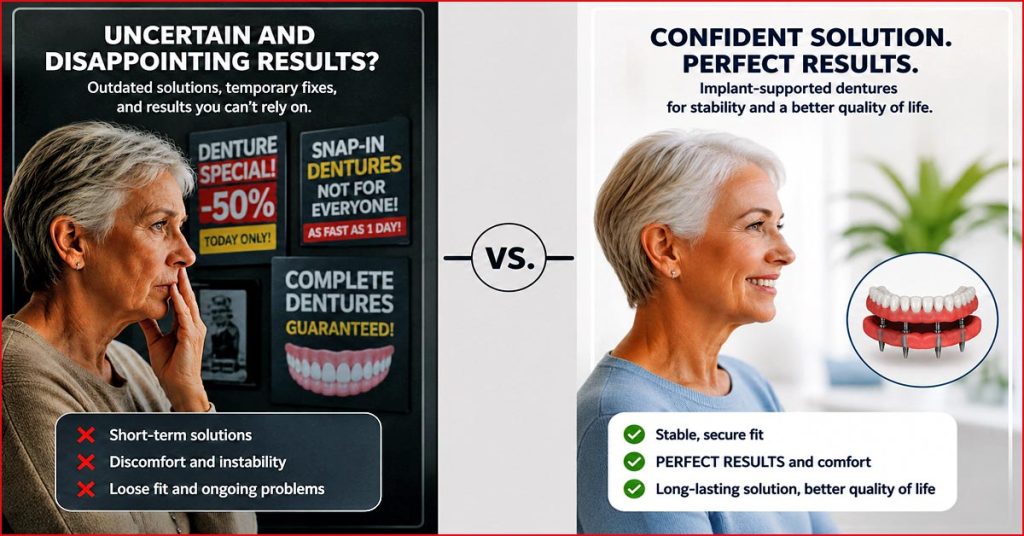
A professional overview of misconceptions and reality in implant dentistry
Introduction
Dental implants are one of the most reliable and long‑lasting solutions available today for restoring missing teeth. Still, many patients feel uncertain because the internet and everyday conversations are full of misunderstandings and misconceptions. This article provides a clear, professionally grounded overview of what is true, what is misleading, and what patients can realistically expect when considering dental implants. The goal is to help every reader make an informed, confident decision.
Background — How Dental Implants Work
A dental implant is an artificial root made of titanium or zirconia that is placed into the jawbone. After the implant placement, two main phases follow:
1. Healing phase (first 1–2 weeks) — soft tissues regenerate — the patient can apply gentle chewing pressure — hard foods should be avoided.
2. Osseointegration phase (3–5 months) — the implant becomes firmly anchored in the bone — long‑term load‑bearing stability develops.
With All‑on‑4 and All‑on‑6 full‑arch solutions, implant placement is typically performed under local anesthesia, and the final prosthesis is completed through a three‑step protocol over approximately 20 days.
Dental implant treatment is not merely a technical procedure — it is a comprehensive process designed to restore chewing function and improve overall quality of life. One of the greatest advantages of modern implant dentistry is predictability: treatments can be planned in advance, outcomes are measurable, and the entire process is transparent for the patient. Digital diagnostics, 3D imaging, and computer‑guided planning ensure that each implant is placed with precision according to the patient’s anatomical conditions.
A detailed consultation is always part of the treatment plan. This is essential because most misconceptions arise from a lack of reliable, professional information. For many people, dental implants are unfamiliar territory, so concerns are natural — but proper education helps patients understand that modern procedures are safe, controlled, and highly predictable.
In many cases, immediate‑load solutions are also available, allowing patients to receive a temporary prosthesis on the day of surgery. Although not final, this temporary restoration provides functional comfort, enabling patients to eat and speak normally during the healing phase.
Dental implants are a long‑term investment in oral health. When properly maintained, they offer stable, durable, and reliable function. Regular check‑ups and consistent home care ensure that implants remain healthy for many years. Most patients report significant improvement in daily comfort and chewing efficiency after treatment.
The Most Common Misconceptions — and the Reality
a./ Misconception: “Dental implant treatment is painful and requires a long recovery.”
Reality: Implant placement is performed under local anesthesia, so patients do not feel pain during the procedure. The healing phase lasts 1–2 weeks and usually involves only mild discomfort, not severe pain. Osseointegration takes longer, but it does not cause daily symptoms.
b./Misconception: “Implants are only recommended for young people.”
Reality: Age alone is not a limiting factor. Many patients between 60 and 80 achieve excellent results with dental implants. What truly matters is overall health and bone quality — not the number of birthdays.
c./ Misconception: “Dental implants always require bone grafting.”
Reality: Modern techniques — especially All‑on‑4 and All‑on‑6 — often allow treatment without bone grafting, even in cases of significant bone loss. Angled implant placement provides stable anchorage, making bone grafting unnecessary in many situations.
d./ Misconception: “Implants are not durable and need frequent replacement.”
Reality: With proper oral hygiene and regular check‑ups, implants can remain stable for decades. Titanium and zirconia are biocompatible materials that integrate well with bone. Most complications involve surrounding tissues — and when detected early, they are manageable.
e./Misconception: “Implant treatment is too complex and risky.”
Reality: Today, implant placement is a routine, predictable procedure with a high success rate. Modern diagnostics (CBCT, digital planning) accurately assess bone conditions, minimizing risks. The entire process is transparent and easy for patients to follow.
f./ Misconception: “Implants will never look as natural as real teeth.”
Reality: Modern implant‑supported restorations provide highly natural esthetics and function. Advanced materials and digital design ensure that the final prosthesis harmonizes with facial features and chewing dynamics.
FAQ — Frequently Asked Questions
- How long does the full process take? — Healing: 1–2 weeks. Osseointegration: 3–5 months.
- When can the implant be loaded? — With immediate‑load systems, a temporary prosthesis can be placed on the day of surgery.
- What type of anesthesia is used? — Implant placement is typically performed under local anesthesia.
- What if there is not enough bone? — In many cases, treatment is still possible without bone grafting — for example, with the All‑on‑4 technique.
- How long do implants last? — With proper care, they can remain stable for decades.
Summary
Dental implants are one of the most reliable and predictable solutions for replacing missing teeth. Misconceptions often create unnecessary fear, while the reality is that modern implant dentistry is safe, durable, and capable of delivering natural‑looking results. With proper information and professional guidance, every patient can make a confident, well‑informed decision.
In our Article section, there are many writings on the following topics: dentures with implants, dental implantation with one-phase and two-phase implants, and
All-On-4 & All-On-6 technology.
We work with state-of-the-art dental tools, materials, and technologies.
30 years of experience, more than 35,000 successful implant placements, and a 99.7% success rate!
iliDent Patient Coordinator © Copyright 2026
iliDent.com