

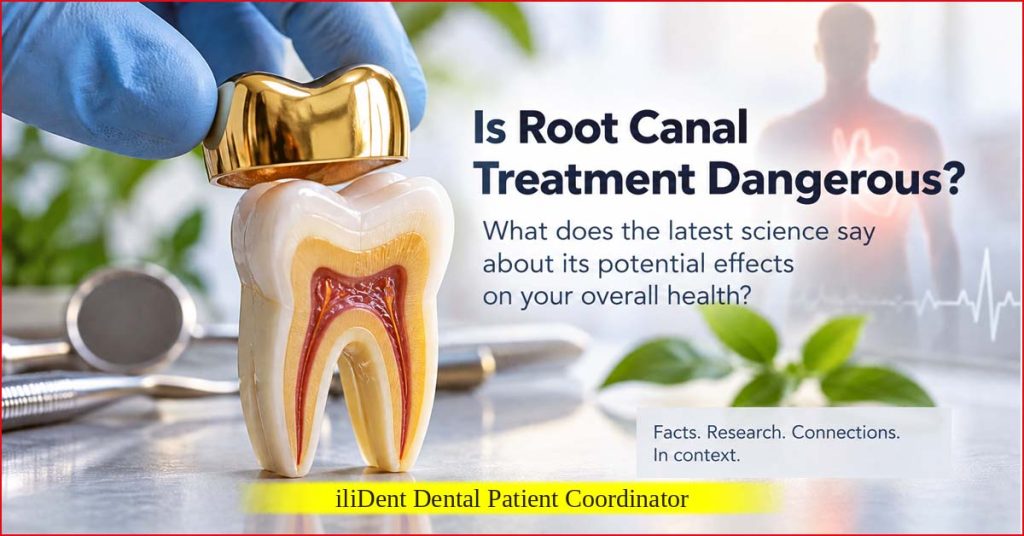
Weston A. Price and the Controversial Theories Surrounding Root Canal Treatment in Light of Current Science
Claims occasionally resurface that bacteria may remain in a root canal-treated tooth, travel to other parts of the body, and contribute to various diseases. This raises an important question: is root canal treatment dangerous, or do the scientific findings present a more nuanced picture? One of the best-known historical proponents of this idea was Weston A. Price, an American dentist who published extensive research in the 1920s concerning the relationship between dental infections and overall health.
What Does Modern Science Say?
This question cannot be answered with a single sentence because three different claims are easily confused with one another:
— Microorganisms can indeed remain in a root canal-treated tooth.
— Inflammation originating from a tooth may have biological effects beyond the local area.
— However, this does not automatically mean that properly performed root canal treatment itself causes systemic disease.
Based on current scientific evidence, there is no convincing evidence supporting the last claim. At the same time, researchers continue to investigate possible connections between endodontic infections and overall health.
Who Was Weston A. Price, and What Did He Claim?
Weston A. Price was a well-known American dentist during the first half of the 20th century. In 1923, he published a two-volume work, with the titles Dental Infections, Oral and Systemic and, for the second volume, Dental Infections and the Degenerative Diseases. In connection with what became known as the focal infection theory, Price investigated how oral and dental infections might affect organs and tissues elsewhere in the body.
One of the central elements of his theory was the idea that bacteria and bacterial products originating from dead or root canal-treated teeth could travel to other parts of the body and contribute to the development of various diseases.
This concept had a significant influence on dentistry at the time. Concern about dental focal infections contributed to the removal of teeth considered non-vital, in some cases even as a preventive treatment. Later scientific developments, however, fundamentally changed this approach.
What Was the Problem With Price’s Research?
There is no need to dispute the historical importance of Price’s work in order to examine how well his findings meet modern scientific standards. Later evaluations identified several methodological problems. These included, for example, the lack of appropriate control groups and experimental conditions that did not allow reliable conclusions to be drawn about whether a root canal-treated tooth actually causes systemic disease in humans.
Historical reviews have concluded that these and other methodological limitations led to increasing doubts about Price’s research over the following decades, while the scientific understanding of endodontic treatment changed substantially. There is an important distinction here.
It is not accurate to say that Price “found nothing.” Based on his own research, he genuinely believed that he had identified important relationships. The problem is that the broader conclusions he drew from those observations were not supported by later research using more rigorous scientific methods in the way required by the classical focal infection theory. This distinction matters. The historical importance of a scientific theory is not the same thing as the strength of the evidence supporting it today.
Can Bacteria Remain in a Root Canal-Treated Tooth?
Yes. But this fact alone does not prove Price’s theory. The purpose of root canal treatment is to remove infected or necrotic pulp tissue, mechanically and chemically clean the root canal system, and then seal it appropriately. The root canal system, however, is an extremely complex anatomical structure. Some areas can be difficult to access. For this reason, one of the most important goals of endodontic treatment is to reduce the microbial burden to a level that allows the surrounding tissues to heal.
Modern endodontic guidelines therefore place particular importance on aseptic technique, appropriate disinfection, proper root canal filling and sealing, and follow-up after treatment. The 2023 S3-level clinical guideline of the European Society of Endodontology states that pulpitis and apical periodontitis are fundamentally microbial diseases. This also means that the statement “a root canal-treated tooth is a completely sterile tooth” would not be accurate. The more important question is whether the infection has been adequately controlled, the cause of inflammation has been addressed, and the tooth can remain functional over the long term.
What Happens If the Infection Persists?
Root canal treatment does not result in immediate or permanent healing in every case. For example, microbial infection may persist within the root canal system, a canal may not be identified or adequately treated, a previous root filling may be inadequate, or the coronal part of the tooth may not provide an appropriate seal. In such cases, a condition known as apical periodontitis — inflammation around the tip of the tooth’s root — may develop or persist.
This is a genuine health problem that requires appropriate evaluation and treatment. Modern endodontics therefore does not claim that a root canal-treated tooth can never develop problems later. On the contrary, the outcome of treatment should be evaluated clinically and, when necessary, radiographically.
The ESE guideline also emphasizes appropriate reassessment after treatment. The key issue, however, is the cause. If persistent infection in a root canal-treated tooth is causing inflammation, the problem is not the fact that the tooth has been root canal treated. The problem is the persistent endodontic disease.
What Do We Know Today About Dental Inflammation and Overall Health?
This is where the story becomes particularly interesting. Modern research has not confirmed the classical focal infection theory in the broad sense that root canal-treated teeth are routinely sources of various systemic diseases. At the same time, there is substantial scientific interest in possible relationships between apical periodontitis and certain systemic conditions. Researchers have investigated possible associations with cardiovascular disease, diabetes, inflammatory diseases, and other conditions.
A 2023 umbrella review identified several such associations, while also finding substantial methodological heterogeneity and varying levels of certainty in the available evidence. A 2025 umbrella review that summarized ten systematic reviews likewise found an association between apical periodontitis and cardiovascular disease. However, the authors also emphasized substantial heterogeneity between studies and limitations in drawing causal conclusions. This distinction is extremely important.
An association is not the same as a cause-and-effect relationship. If two conditions occur more frequently together, that does not automatically mean that one causes the other. For this reason, the current scientific position is considerably more cautious than the historical focal infection theory.
Interestingly, Some Inflammatory Markers May Decrease After Successful Treatment
Modern research has also moved in another direction. Researchers are not only asking whether apical periodontitis may be associated with certain systemic conditions. They are also examining what happens in the body after an endodontic infection has been successfully treated. A systematic review and meta-analysis published in 2025 found that certain circulating inflammatory biomarkers, including high-sensitivity C-reactive protein (hs-CRP) and IL-1β, decreased after successful endodontic treatment.
The authors nevertheless emphasized the need for further clinical research to determine whether these biomarker changes actually affect the clinical outcomes of systemic diseases. This is interesting because it raises another possible biological connection.
If a tooth has a persistent infection and inflammation, these processes may have biological effects beyond the immediate local area. Some studies suggest that apical periodontitis may be associated with higher levels of certain inflammatory blood markers. This has led researchers to ask what happens to these inflammatory processes when the endodontic infection is appropriately treated.
Some recent studies suggest that certain inflammatory biomarkers may decrease after successful endodontic treatment. This does not mean, however, that root canal treatment treats or prevents systemic disease.
Based on the current evidence, the most that can reasonably be said is that eliminating an existing endodontic infection may produce favorable changes in certain inflammatory processes. Whether these changes have a clinically meaningful effect on overall health remains a question for further research.
Is Root Canal Treatment More Dangerous Than Tooth Extraction?
According to current professional guidelines, when a tooth can be appropriately treated and predictably preserved, the general principle is not to extract it simply because of a presumed systemic risk.
The European Society of Endodontology’s 2023 S3-level clinical guideline recommends root canal treatment, appropriate restoration, and post-treatment care rather than extraction for a restorable tooth with apical periodontitis. The decision must, of course, be based on the prognosis of the individual tooth, anatomical and technical circumstances, the patient’s preferences, and other relevant factors. This approach differs substantially from the logic suggested by the classical focal infection theory. The modern goal is primarily to preserve the natural tooth whenever it can be treated appropriately and predictably.
The American Dental Association’s guidance likewise emphasizes that the primary treatment for pulpal and periapical dental problems is appropriate dental intervention, such as pulpotomy, pulpectomy, root canal treatment, or drainage when necessary. Antibiotics do not replace local treatment of the dental infection. When systemic symptoms such as fever or general malaise are present, the role of antibiotics is considered differently.
When Can a Root Canal-Treated Tooth Actually Become a Problem?
A root canal-treated tooth does not need to be monitored because every root canal-treated tooth is dangerous
It needs to be monitored because disease can develop or persist even in a previously treated tooth.
Follow-up is particularly important when:
— The tooth has previously undergone unsuccessful root canal treatment.
— Persistent or recurrent pain, sensitivity, or swelling occurs.
— A radiographic abnormality is visible around the tooth.
— The previous root canal treatment is technically inadequate.
— There is a possibility that a root canal was missed or inadequately treated.
— The coronal seal of the tooth is inadequate.
— A lesion around the root tip does not heal appropriately after previous root canal treatment.
In such cases, extraction is not necessarily the only option.
Depending on the condition of the tooth, retreatment or, in certain situations, surgical endodontic treatment may be possible.
The appropriate option must always be determined based on the individual tooth and its prognosis.
So, Is Root Canal Treatment Dangerous or Not?
Based on current scientific evidence, it is not accurate to claim that properly performed root canal treatment itself is a systemic health hazard. Weston A. Price’s historical work is an important part of the history of endodontics, but the broad form of the classical focal infection theory has not been supported by subsequent scientific evidence. The methodological limitations of Price’s research have also been documented in later scientific reviews.
At the same time, it would not be scientifically correct to say that there is absolutely no relationship between dental conditions and overall health. The possible relationships between apical periodontitis and certain systemic diseases continue to be actively investigated. There are interesting and potentially important findings, but in many areas the available evidence is still not strong enough to establish a reliable cause-and-effect relationship.
The current position is therefore considerably more nuanced:
The focus should not be on treating root canal treatment itself as a systemic danger. The important issue is ensuring that any infection affecting the tooth and surrounding tissues is treated appropriately, that the tooth is properly restored, and that healing can be monitored.
This also means that Weston A. Price’s claims from more than a century ago should be examined in their historical and scientific context rather than treated unchanged as established medical facts today.
Frequently Asked Questions
Can bacteria remain in a root canal-treated tooth? – Yes. The goal of root canal treatment is to eliminate or substantially reduce the microbial burden and then properly seal the root canal system. Treatment success does not depend on making the tooth literally “sterile.” The more important question is whether the infection can be controlled and whether the surrounding tissues heal.
Did Weston A. Price believe that root canal-treated teeth could cause disease? – Price investigated the relationship between dental infections and systemic diseases and drew conclusions associated with the focal infection theory. His major works on the subject were published in 1923.
Can a root canal-treated tooth cause heart disease according to current science? – There is no adequate evidence that a properly treated root canal-treated tooth, by itself, causes heart disease. At the same time, statistical associations between apical periodontitis and cardiovascular disease have been investigated and require further research.
Does a problematic root canal-treated tooth have to be extracted? – Not necessarily. If the tooth can be preserved, current endodontic approaches may include retreatment or, in certain cases, surgical treatment. Extraction depends on the prognosis of the individual tooth and the available treatment options.
What is most important if there is concern about an old root canal-treated tooth? – It is not advisable to base the decision solely on the fact that the tooth has been root canal treated. The actual questions are whether there is currently an infection, inflammation, or another abnormality, and what condition the tooth is in. This can be assessed through a clinical examination and, when necessary, appropriate imaging.
Summary
Weston A. Price’s research played an important historical role in debates about dental infections and systemic health, but the broad claims of the classical focal infection theory have not been supported by subsequent scientific evidence. Modern endodontic treatment aims to eliminate infection, preserve the natural tooth, and restore its function whenever the tooth can be treated appropriately.
At the same time, researchers continue to investigate the biological and epidemiological relationships that may exist between apical periodontitis and overall health. Some findings are noteworthy, but it remains essential to distinguish an association from a cause-and-effect relationship. The most important conclusion is therefore neither that “every root canal-treated tooth is dangerous” nor that “root canal treatment can never involve any risk.”
Based on the current state of scientific knowledge, the question can be stated more precisely: The purpose of a well-planned and properly performed root canal treatment is not to create a potential systemic health hazard. Its purpose is to preserve an infected tooth and eliminate or control the infection. Therefore, the claim that root canal treatment itself is dangerous is not supported by current evidence. If, however, infection or inflammation persists in a previously root canal-treated tooth, it should be evaluated and treated when necessary.
In our Articles section, you’ll find a wide range of articles covering dental restorations with implants, one-stage and two-stage implant treatment, as well as All-on-4 and All-on-6 treatment options. We use modern equipment and materials, backed by more than 30 years of experience, 35,000 successful implant placements, and a 99.7% success rate. If you have questions, you can find answers in our Dental Implants | Fogpótlás Implantátummal Facebook group.
iliDent Dental Patient Coordinator © Copyright 2026
iliDent.com
Glossary of Terms
Apical / Apical Periodontitis – “Apical” refers to the tip of the tooth’s root. Apical periodontitis is inflammation around the root tip, most commonly resulting from an infection inside the tooth.
Asepsis – A set of procedures and principles designed to prevent the introduction and spread of pathogenic microorganisms during treatment.
Biomarker – A measurable biological substance, characteristic, or process that can indicate a physiological or pathological condition. In this article, the term refers primarily to inflammatory biomarkers.
Endodontics – The branch of dentistry concerned primarily with diseases of the dental pulp, root canal system, and tissues surrounding the root tip, as well as their treatment. Root canal treatment is an endodontic procedure.
Endodontic / Endodontics – Related to endodontics — that is, the inside of the tooth, the root canal system, and the tissues surrounding the root tip.
ESE – The European Society of Endodontology, a professional organization involved, among other things, in developing evidence-based endodontic guidelines.
Focal Infection Theory – A historical medical theory proposing that a localized infection, such as a dental infection, can cause disease or damage in distant parts of the body. The broad classical version of this theory has not been supported by subsequent scientific evidence.
Root Canal – A canal inside the root of a tooth that originally contains the pulp tissue, including nerves and blood vessels. During root canal treatment, this space is cleaned, disinfected, and sealed.
IL-1β (Interleukin-1 Beta) – A signaling molecule involved in the body’s inflammatory processes. Its levels may change in certain inflammatory conditions.
Causal Relationship – A cause-and-effect relationship. If two phenomena have a causal relationship, one directly contributes to the development of the other. This is an important distinction from a statistical association.
Microbial / Microorganism – “Microbial” refers to microorganisms, such as bacteria. Microorganisms are generally biological organisms or systems that cannot be seen with the naked eye.
Meta-analysis – A statistical method that combines the results of multiple studies investigating similar questions. It can provide an estimate based on a larger body of data, although the reliability of the result depends on the quality of the underlying studies.
Periapical – A term referring to the area surrounding the tip of a tooth’s root. A “periapical lesion,” for example, is a pathological change occurring around the root tip
Pulp – The soft tissue inside the tooth containing blood vessels, nerves, and other cells. It is often referred to as the dental pulp.
Pulpitis – Inflammation of the dental pulp. It may develop, for example, as a result of deep tooth decay or other dental damage.
Pulpectomy – Removal of the entire dental pulp. It is often one of the steps involved in root canal treatment.
Pulpotomy – Removal of part of the inflamed or affected pulp while leaving some pulp tissue inside the tooth.
Radiographic / Radiology – Related to imaging examinations and the evaluation of such images. In dentistry, radiographs can be used, for example, to examine the area around the tip of a tooth’s root.
Systemic – Refers to a process that affects or extends throughout the body, rather than being limited to a local area.
S3-Level Clinical Guideline – A high-level, evidence-based clinical guideline. Such guidelines are based on systematic evaluation of available scientific evidence and are designed to support healthcare decision-making.
Systematic Review – A scientific review that uses a predefined methodology to identify, evaluate, and summarize research available on a specific question.
Systemic Disease – A disease or condition that is not limited to a single local area but affects the body as a whole or multiple organ systems.
Umbrella Review – An “overview of reviews” – it isa higher-level scientific review that examines and summarizes the findings of multiple systematic reviews and/or meta-analyses.
hs-CRP (High-Sensitivity C-Reactive Protein) – CRP is a laboratory marker associated with inflammatory processes in the body. High-sensitivity CRP testing can detect relatively low concentrations of CRP in the blood.
Weston A. Price – An American dentist who investigated the relationship between dental infections and overall health during the 1920s. His work is an important historical part of the development of the focal infection theory, although many of his conclusions were subsequently challenged by scientific research.