

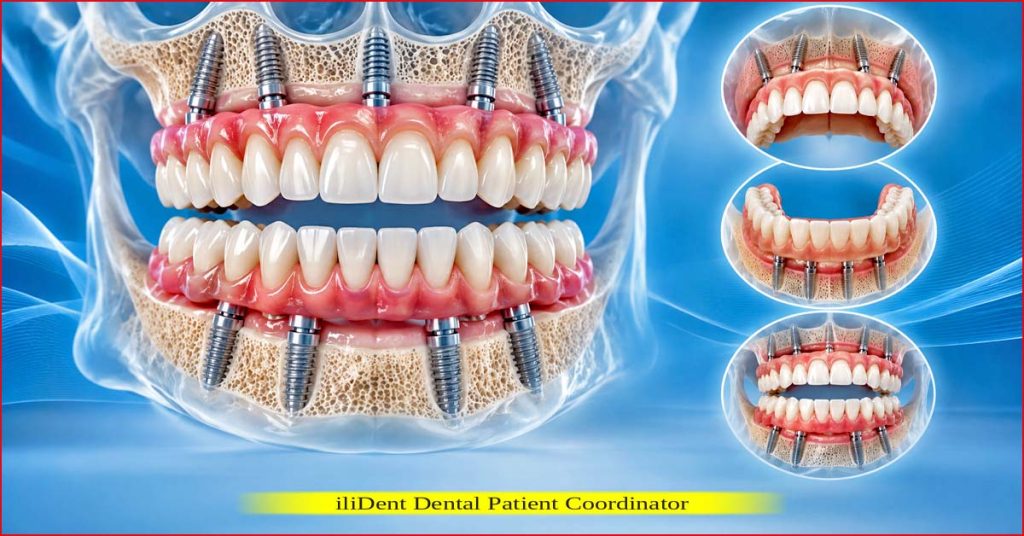
Which implant-supported solutions are used for full-mouth oral rehabilitation?
Introduction
When a patient needs more than one or a few missing teeth replaced and the goal is to restore an entire dental arch, the treatment requires a different approach. At that point, the most important question is not simply, “Which implant should I get?” The real question is which type of tooth replacement best fits the patient’s oral condition and the extent of the restoration needed.
Implant-supported tooth replacement can be part of a full-mouth oral rehabilitation in several ways. Depending on the individual situation, possible solutions may include one-stage implants, two-stage implants, All-on-4, or All-on-6.
The appropriate option cannot be determined simply by counting the missing teeth. The overall condition of the mouth must be evaluated, with particular attention to the upper or lower jaw and the amount and condition of available bone.
When Does Tooth Replacement Become a Full-Mouth Rehabilitation?
Replacing one or a few missing teeth does not necessarily mean that a patient needs full-mouth rehabilitation. The situation becomes different when the objective is to restore an entire dental arch or to replace a remaining dentition that can no longer be treated successfully.
Examples include:
— Complete tooth loss in the upper jaw.
— Complete tooth loss in the lower jaw.
— Complete tooth loss in both jaws.
— Remaining teeth in the upper jaw, lower jaw, or both that are no longer suitable for further dental treatment. In these situations, the task is no longer simply to replace individual missing teeth. The goal is to plan a complete tooth replacement, taking the condition of the jaw and, when necessary, both jaws into consideration.
Why Does the Starting Condition Matter?
Before planning a full-mouth restoration, the first step is to understand exactly what needs to be restored.
A complete tooth replacement in the upper jaw is not necessarily the same treatment situation as a complete restoration of the lower jaw. Planning is also different when both jaws require rehabilitation.
Another important situation occurs when some natural teeth are still present, but they are no longer suitable for further treatment. In that case, it is not enough to count only the teeth that are already missing. The entire dentition has to be considered because the objective has changed from replacing individual teeth to restoring the complete dental situation.
Several factors therefore need to be evaluated together:
— The overall condition of the patient’s mouth.
— Whether the upper jaw, lower jaw, or both are involved.
— Whether natural teeth are still present and, if so, what condition they are in.
— The extent of tooth loss.
— The condition and available volume of the jawbone.
— The type of complete tooth replacement that is being planned.
The condition of the bone is particularly important. The implant-supported solution must be compatible with the amount and condition of bone available in the relevant jaw. This is why two patients with apparently similar tooth loss may not necessarily receive the same treatment recommendation.
What Implant-Supported Solutions May Be Considered?
Several implant-supported approaches may be considered when a patient needs complete tooth replacement and oral rehabilitation. These include one-stage implants, two-stage implants, All-on-4, and All-on-6.
None of these options should automatically be considered suitable for every patient. The appropriate solution depends on the individual oral situation and, in particular, the condition of the available bone.
Oral Rehabilitation With One-Stage Implants
A one-stage implant approach is one of the possible options for complete tooth replacement and oral rehabilitation. Its suitability cannot be determined simply because a patient needs a complete restoration. The available bone and the overall condition of the mouth must first be assessed.
A characteristic of this approach is that implant placement is completed in a single surgical phase. Depending on the individual situation, it may also be considered when there is a certain degree of bone deficiency.
The important point is that one-stage implantation is not simply a technology that a patient chooses in advance. Its suitability has to be determined through professional evaluation of the patient’s specific situation.
Oral Rehabilitation With Two-Stage Implants
Two-stage implant treatment can also be used for complete tooth replacement and oral rehabilitation. Here again, the decision depends on the patient’s individual circumstances. The condition of the jaw and the available bone play an important role in determining whether this approach is appropriate.
The defining characteristic is that implant treatment is performed in two separate stages. This approach requires suitable bone conditions for the planned treatment. The key point is therefore not that a patient decides in advance to have a two-stage implant. Rather, the treatment plan should establish whether this approach fits the particular tooth-replacement situation.
Oral Rehabilitation With All-on-4
All-on-4 is another approach that may be used for complete tooth replacement and oral rehabilitation. The name primarily refers to the implant arrangement used to support the restoration. However, from the patient’s perspective, the number of implants is not the most important question. What matters is whether the overall treatment plan is appropriate for the patient’s oral condition.
The condition of the jaw and available bone must therefore be assessed before deciding whether All-on-4 is suitable. It is not a solution that can automatically be applied to every case of complete tooth loss.
The All-on-4 approach uses four implants, with two positioned in a specialized way, to support the full-arch restoration. The treatment requires suitable bone conditions for the planned implant placement.
Oral Rehabilitation With All-on-6
All-on-6 is another possible solution for complete tooth replacement and oral rehabilitation. As with the other approaches, the decision cannot be based solely on the extent of tooth loss. The entire oral situation and the condition of the jawbone need to be evaluated.
The basic treatment concept is similar to All-on-4, but six implants are placed in each jaw when this approach is selected. Because the load is distributed across a greater number of implants, the bone requirements may be less restrictive than with an All-on-4 approach in certain situations.
Again, the relevant question is not simply whether six implants are better than four. The appropriate solution depends on the individual anatomical and restorative situation.
What Determines Which Solution Should Be Recommended?
Choosing between one-stage implants, two-stage implants, All-on-4, and All-on-6 is one of the most important parts of planning a complete tooth replacement. There is no universal rule that makes one solution better for every patient. The relevant question is which option can be appropriately used in the individual patient’s situation and fits the planned restoration.
Several factors need to be considered together:
— What is the overall condition of the patient’s mouth?
— Is the upper jaw, lower jaw, or both involved?
— Are natural teeth still present, and what condition are they in?
— How extensive is the tooth loss?
— What is the condition of the jawbone and how much bone is available?
— What type of complete tooth replacement is the treatment intended to provide?
These questions have to be considered as a whole.
The condition of the bone is particularly important because the available bone determines which implant-supported approaches can be considered in a given jaw. As a result, even patients who appear to have a similar tooth-replacement situation may receive different treatment recommendations.
One-Stage, Two-Stage, All-on-4, or All-on-6?
The four approaches cannot be selected according to a general rule. All four may be used in complete tooth replacement and oral rehabilitation, but the appropriate option has to be determined from the patient’s individual oral and anatomical circumstances. The most important difference is therefore not which technology sounds newer, simpler, or more advanced. The important question is which approach fits the patient’s anatomy and the planned tooth replacement.
This leads to an important practical conclusion for patients: it is generally not advisable to commit to one specific implant solution before the oral situation has been properly assessed. First, the condition of the mouth and jawbone needs to be understood. Then, based on those findings, an appropriate rehabilitation approach can be planned.
Why Is Individualized Treatment Planning Important?
Complete tooth replacement is not simply an expanded version of replacing a single tooth. When the objective is to restore the entire dentition of the upper jaw, the lower jaw, or both jaws, the treatment has to be planned around the complete oral situation.
This becomes particularly important when some natural teeth remain but are no longer suitable for further dental treatment. In that situation, the objective is not merely to replace the teeth that have already been lost. The treatment plan needs to consider whether and how the entire dentition can be restored.
The implant-supported solution is therefore one part of a broader rehabilitation plan. The starting point should always be the patient’s actual condition, not a predetermined technology.
Patient-Specific Subperiosteal Implants – An Option for Severe Bone Loss
In some cases of implant-supported oral rehabilitation, the amount or shape of the available bone may significantly limit the use of conventional implants placed directly into the jawbone. In such situations, a specialized option known as a subperiosteal implant may be considered.
Unlike conventional endosseous implants, a subperiosteal implant is not placed inside the bone. Instead, it consists of a custom-designed framework that sits on the surface of the jawbone, beneath the periosteum. Modern versions are designed using 3D imaging and digital planning and are individually manufactured to match the patient’s specific anatomy.
This can be particularly relevant in cases of severe jawbone atrophy. A subperiosteal implant may provide an implant-supported treatment option when conventional implant placement would require extensive bone augmentation or when bone grafting is not considered an appropriate solution.
One of the key advantages of this approach is therefore that it can be adapted to the existing bone surface and may provide an implant-supported solution even in severely resorbed jaws. In selected cases, this may eliminate the need for extensive bone-grafting procedures and the longer treatment process associated with them.
At the same time, a subperiosteal implant is not a simpler version of conventional implant treatment. It is a complex procedure requiring a high level of precision in both digital planning and surgery, together with appropriate clinical experience and specialized technical resources.
There are also disadvantages. The procedure may be more complex, requires patient-specific planning and custom manufacturing, and may involve a higher cost than conventional implant treatment. Biological or mechanical complications can still occur despite modern technology. Therefore, careful assessment of whether this treatment is appropriate and feasible for the individual patient, together with precise treatment planning, is particularly important.
A subperiosteal implant is therefore not a universally applicable solution for every patient. It may be particularly relevant in complex cases where severe bone loss limits conventional implant options and a patient-specific approach may provide an alternative treatment pathway.
Frequently Asked Questions
Which implant-supported solutions may be used for complete tooth replacement?
Depending on the individual situation, possible solutions include one-stage implants, two-stage implants, All-on-4, and All-on-6. The appropriate option must be determined from the patient’s oral condition, including the condition of the available bone.
Can an entire upper dental arch be replaced with implants?
Yes. Complete tooth loss in the upper jaw can be treated with an implant-supported full-arch restoration. The appropriate approach depends on the patient’s individual oral and bone condition.
Can an entire lower dental arch be replaced with implants?
Yes. Implant-supported solutions can also be used for complete tooth replacement in the lower jaw. As with the upper jaw, the condition of the jawbone is an important part of treatment planning.
How is the choice between one-stage and two-stage implants made?
The choice depends on the patient’s individual circumstances. The overall oral condition and, in particular, the condition of the jaw and available bone are important factors in determining which approach may be appropriate.
When may All-on-4 or All-on-6 be considered?
Both approaches may be considered for complete tooth replacement and oral rehabilitation. The appropriate option cannot be determined from the extent of tooth loss alone. The entire oral and bone condition must be evaluated.
If both jaws need complete tooth replacement, does the same solution have to be used in both?
Not necessarily. The condition of the upper and lower jaws may differ, so each jaw may require its own treatment plan based on its anatomical and restorative circumstances. In many cases, however, the same type of solution may be used for both jaws.
Summary
Implant-supported tooth replacement can be used in several ways as part of full-mouth oral rehabilitation. Depending on the individual situation, treatment may involve one-stage or two-stage implants, All-on-4, or All-on-6. If complete tooth replacement is needed in the upper jaw, lower jaw, or both, the appropriate implant-supported solution should be considered only after the oral and bone conditions have been evaluated.
There is no single solution that can be recommended in advance for every patient. The treatment plan depends on the overall oral situation, the rehabilitation goal, the jaw or jaws involved, and particularly the condition and availability of bone. For this reason, the first step is not to choose a particular implant technology. The first step is to understand the patient’s individual anatomical and restorative situation. Once that has been established, the appropriate rehabilitation options can be considered.
In our Articles section, you’ll find a wide range of articles covering dental restorations with implants, one-stage and two-stage implant treatment, as well as All-on-4 and All-on-6 treatment options.
We use modern equipment and materials, backed by more than 30 years of experience, 35,000 successful implant placements, and a 99.7% success rate. If you have questions, you can find answers in our Dental Implants | Fogpótlás Implantátummal Facebook group.
iliDent Dental Patient Coordinator © Copyright 2026
iliDent.com