

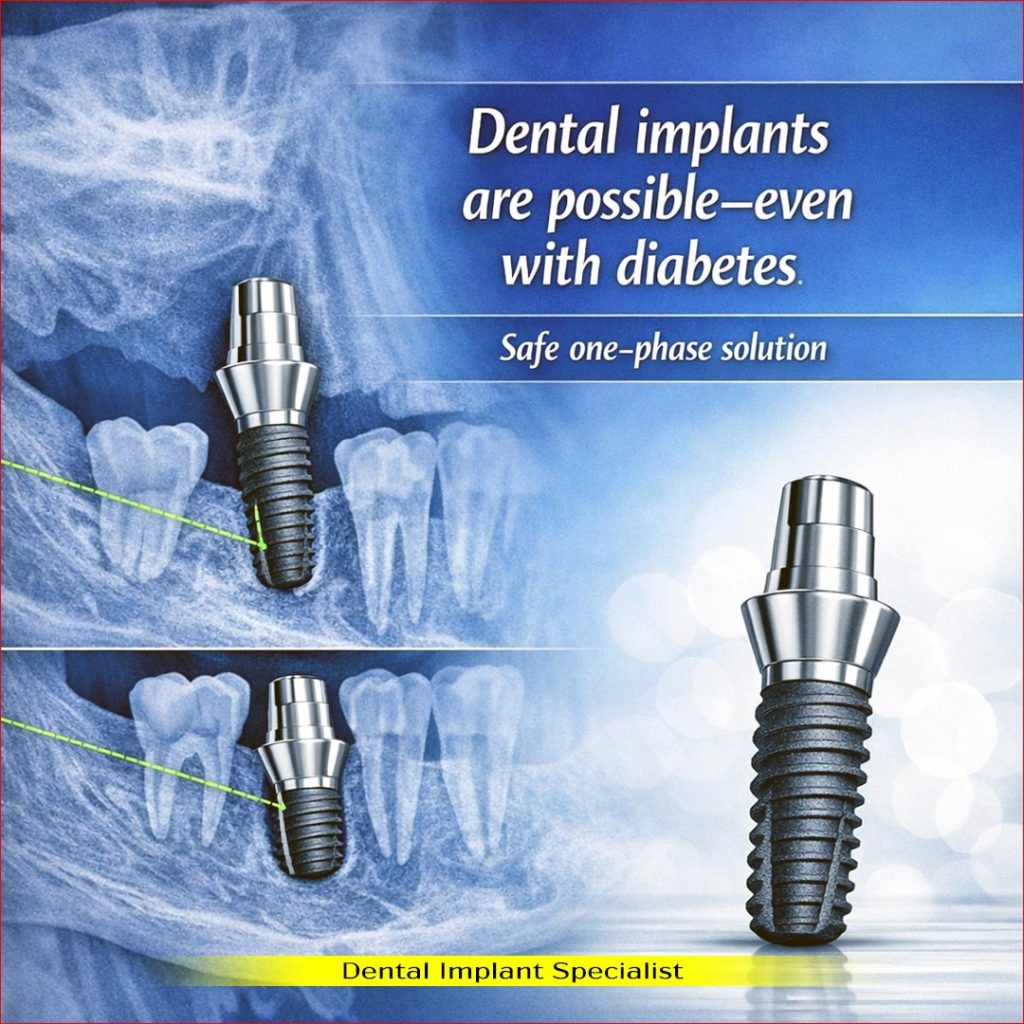
Successful Implant Treatment in a Diabetic Patient – Case Study
Introduction
Many patients believe that dental implants in a diabetic patient are not possible, and they often assume their condition automatically excludes them from treatment. This case study presents a 55‑year‑old man who postponed tooth replacement for years because he feared rejection due to diabetes. Modern diagnostics and a well‑controlled metabolic status, however, made a safe and predictable one‑phase implant treatment entirely achievable.
Patient background and initial concerns
The patient — let’s call him Peter — had been living with type 2 diabetes for more than a decade. Although his HbA1c levels were stable, his dental condition gradually worsened, and a long‑standing inflammation eventually led to the loss of a lower molar. Before visiting our clinic, he received discouraging feedback from several practices, reinforcing his belief that dental implants in a diabetic patient were unsafe or impossible.
First consultation: relief within minutes
During the initial assessment, it became clear that Peter’s concerns were unfounded. Controlled diabetes is not a contraindication, and modern one‑phase implants are particularly suitable for such cases.
The consultation included:
— reviewing his general health and recent laboratory results,
— performing a CBCT scan to evaluate bone structure,
— ensuring a healthy, inflammation‑free environment with professional cleaning.
The CBCT scan confirmed adequate bone volume and no need for grafting. Peter expressed visible relief, saying: “I honestly thought this wasn’t possible for me.”
Treatment Plan: One‑Phase Implant in a Single Procedure
A one‑phase implant was chosen as the safest and most minimally invasive solution. For diabetic patients, this approach offers several advantages:
— minimally invasive technique,
— shorter surgical time,
— reduced tissue trauma,
— faster initial healing,
— stable primary fixation.
The treatment plan included:
— preparation and professional cleaning,
— placement of a one‑phase implant under local anesthesia,
— immediate temporary crown,
— healing phase during the first 1–2 weeks,
— osseointegration over the following months,
— fabrication of the final crown.
Surgery day: fast, comfortable, predictable
Peter arrived nervous, but the procedure was simpler than expected.The surgical steps were:
— local anesthesia,
— precise implant positioning based on CBCT data,
— placement of the one‑phase implant with stable primary fixation, — attachment of the temporary crown.
The entire procedure took less than 40 minutes. His first reaction was: “That’s it? I thought it would be much worse.”
Healing: smooth, controlled, and predictable
1. Healing Phase (first 1–2 weeks)
— mild swelling for one day,
— minimal discomfort,
— adherence to hygiene and dietary instructions,
— excellent healing at follow‑up.
2. Osseointegration Phase (following months)
— continuous improvement in implant stability,
— healthy surrounding tissues,
— diabetes remained well controlled.
By the end of the osseointegration period, the implant was fully integrated.
Final crown and patient feedback
After the final crown was placed, Peter regained full chewing function on the side where he had been missing a tooth for years. His summary was simple but powerful: “I postponed this for so long because I thought diabetes ruled me out. Now I know I just needed the right clinic.” This case clearly demonstrates that dental implants in a diabetic patient can be safe, predictable, and life‑changing when the condition is well controlled.
FAQ – Frequently Asked Questions
1. Can diabetic patients receive dental implants? — Yes, if diabetes is well controlled and lab results are stable.
2. Are one‑phase implants suitable for diabetic patients? — Yes, they are minimally invasive and offer predictable healing.
3. How long is the healing period? — The first 1–2 weeks cover initial healing, followed by several months of osseointegration.
4. Is bone grafting necessary? — Not always. A CBCT scan determines whether grafting is required.
5. Are dental implants in a diabetic patient riskier than in non‑diabetic patients? — With controlled diabetes and proper planning, risks are comparable.
Summary
This case study demonstrates that dental implants in a diabetic patient are entirely feasible when the condition is well managed. Peter’s experience shows how modern diagnostics, one‑phase implant technology, and a stable metabolic profile can transform a situation once believed impossible. Instead of fear and uncertainty, he experienced a safe procedure, smooth healing, and restored chewing function — proving that diabetes does not have to stand in the way of successful implant treatment.
In our Articles section, you can find numerous articles on dental implants, single-stage and two-stage implant placement, as well as All-on-4 and All-on-6 technologies. We work with the most modern equipment and materials, backed by over 30 years of experience, 35,000 successful implant placements, and a 99.7% success rate. Get answers to your questions in our Fogpótlás Implantátummal | Dental Implants Facebook group.
iliDent Patient Coordinator © Copyright 2026
iliDent.com