

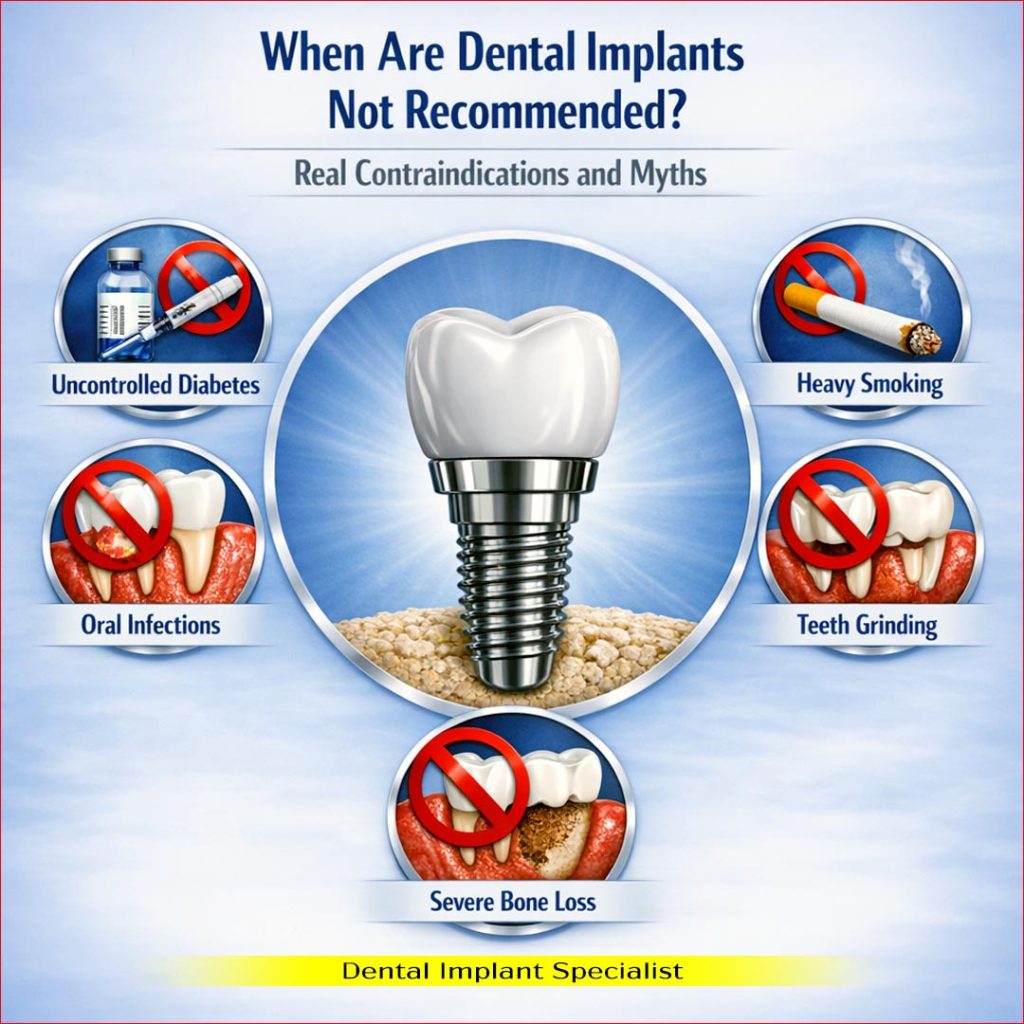
Who is dental implant placement not recommended for? Real contraindications and misconceptions clarified so you can make a confident decision
Introduction
Dental implant placement is one of the safest and most predictable tooth replacement solutions available today, yet many patients still feel uncertain about whether they are suitable candidates. The topic of “when implant placement is not recommended” is often surrounded by misconceptions, outdated beliefs, and misunderstandings. This article aims to clearly and professionally explain the real contraindications and help you understand when preparation is needed, when simply waiting for the healing phase is enough, and when an alternative solution may be the safer choice.
Understanding these factors is essential not only for patients but also for caregivers and referring dentists. Making an informed decision about implant placement requires clarity, not fear — and that clarity begins with separating facts from outdated assumptions.
Why is it important to clarify who is not recommended for implant placement?
Many patients arrive at their consultation already convinced that they are “probably not suitable” for implant placement. Common statements include:
— “I don’t have enough bone, so it’s impossible.”
— “I have diabetes, so I was told I can’t get implants.”
— “I smoke, so it will definitely fail.”
The reality is far more nuanced. Thanks to modern diagnostics, metal‑free options, advanced bone grafting techniques, and personalized treatment planning, the number of true contraindications is much smaller than it used to be. The goal is never to exclude someone — it is to find the safest, most stable long‑term solution, whether that involves implant placement or another type of denture‑based restoration.
When is dental implant placement not recommended? Real contraindications
Implant placement is a surgical procedure that relies on the success of both the healing phase and the osseointegration phase. Certain conditions can temporarily or permanently interfere with these processes.
Untreated, severe general health conditions
Some medical conditions can reduce the body’s ability to heal. These may include:
— uncontrolled diabetes,
— severe bleeding disorders,
— active cancer or ongoing chemotherapy,
— severe immunodeficiency.
Important: In most cases, it is not the condition itself but its untreated form that poses a real risk.
Certain medications — such as bisphosphonates used for osteoporosis — may also affect bone healing and osseointegration. Patients undergoing radiation therapy in the head and neck region require special evaluation. These are not automatic exclusions, but they do require careful planning and coordination with medical specialists.
Psychological readiness and realistic expectations also matter. Patients with extreme anxiety or unrealistic expectations may benefit from additional counseling or alternative treatment options.
Active oral inflammation
Periodontal disease, untreated gingivitis, or acute infections must be resolved before implant placement. The healing phase can only begin in a clean, stable environment.
Severe bone deficiency that cannot be restored
Modern bone grafting techniques solve most cases, but in rare situations the bone quality or quantity is insufficient for stable implant placement.
Heavy smoking
Smoking impairs healing and increases the risks associated with the osseointegration phase. It is not an absolute contraindication, but it is a significant risk factor that must be evaluated together with the patient.
Severe bruxism (nighttime teeth grinding)
Excessive force can compromise implant stability. In many cases, a night guard or pre‑treatment can manage the issue, but bruxism remains a risk factor.
Misconceptions — What is NOT a contraindication?
Patients often arrive with “forbidden lists” that are no longer valid. Here are the most common misconceptions:
“I don’t have enough bone, so implants are impossible.”
Reality: Bone grafting is routine today and often provides a complete solution.
“I have diabetes, so implants are not allowed.”
Reality: Well‑controlled diabetes is not a contraindication.
“You can’t get implants after age 50–60.”
Reality: Age alone is never a disqualifying factor.
“Metal allergies prevent implant placement.”
Reality: Zirconia implants offer a fully metal‑free alternative.
“My denture or tooth loss is too old to fix.”
Reality: With modern diagnostics and planning, a solution can be found in nearly every case.
Another common myth is that implant placement is “too painful” or “too invasive.” In reality, most patients report minimal discomfort during and after the procedure, especially when performed by experienced professionals using modern techniques. Local anesthesia is typically sufficient, and post-operative pain is usually manageable with over-the-counter medication.
Some patients also believe that implants are only for younger individuals or those with perfect oral health. This is not true — implants are often the best solution for older adults who want to avoid removable dentures and maintain their quality of life.
How do we determine whether someone is suitable for implant placement?
The decision is never guesswork — it is based on precise diagnostics.
Panoramic X‑ray and/or 3D CBCT scan
These reveal bone quantity, bone quality, and surrounding anatomical structures. The CBCT scan is particularly valuable because it provides a 3D view of the jawbone, allowing the dentist to assess bone density, nerve location, and sinus proximity. This ensures that implant placement is not only possible but also safe and precisely planned.
Evaluation of general health
The goal is not exclusion — it is identifying the safest treatment path.
Personalized treatment plan
Based on the condition of the denture, bone structure, bite, and lifestyle. Digital smile design or mock-up models may also be used to help patients visualize the final result.
Preparatory treatments, if needed
— inflammation management,
— bone grafting,
— night guard,
— smoking reduction.
Implant placement and the healing phase
The first 1–2 weeks are the healing phase, followed by several months of osseointegration.
FAQ — Frequently Asked Questions
Can smokers get dental implants? – Yes, but heavy smoking increases the risk of complications. Patients are encouraged to reduce or quit smoking before and after the procedure to improve healing and long-term success.
What if I have osteoporosis? – Osteoporosis itself is not a contraindication. However, certain medications like bisphosphonates may affect bone healing. Your dentist will evaluate your medical history and coordinate with your physician if needed.
Is implant placement painful? – Most patients report minimal discomfort. The procedure is usually done under local anesthesia, and post-operative pain is manageable with standard medication.
Can older adults get implants? – Absolutely. Age is not a limiting factor. In fact, many patients over 60 choose implants to avoid removable dentures and improve their quality of life.
What if I’ve had missing teeth for many years? – Long-term tooth loss may lead to bone resorption, but modern bone grafting techniques can often restore the area and make implant placement possible.
Summary
Dental implant placement is extremely safe and predictable today, and the number of true contraindications is far smaller than most people assume. “Implant placement not recommended” is rarely a final verdict — it usually describes a temporary condition that can be resolved with proper preparation or treatment. The goal is always the same: to provide the patient with a long‑term stable, healthy, and comfortable tooth replacement — whether through implant placement or another solution.
If you’ve been told that implants are not an option for you, consider seeking a second opinion from a clinic that specializes in advanced diagnostics and personalized treatment planning. You may discover that a safe and effective solution is still within reach.
In our Articles section, you can find numerous articles on dental implants, single-stage and two-stage implant placement, as well as All-on-4 and All-on-6 technologies. We work with the most modern equipment and materials, backed by over 30 years of experience, 35,000 successful implant placements, and a 99.7% success rate. Get answers to your questions in our Fogpótlás Implantátummal | Dental Implants Facebook group.
iliDent Patient Coordinator © Copyright 2026
iliDent.com