

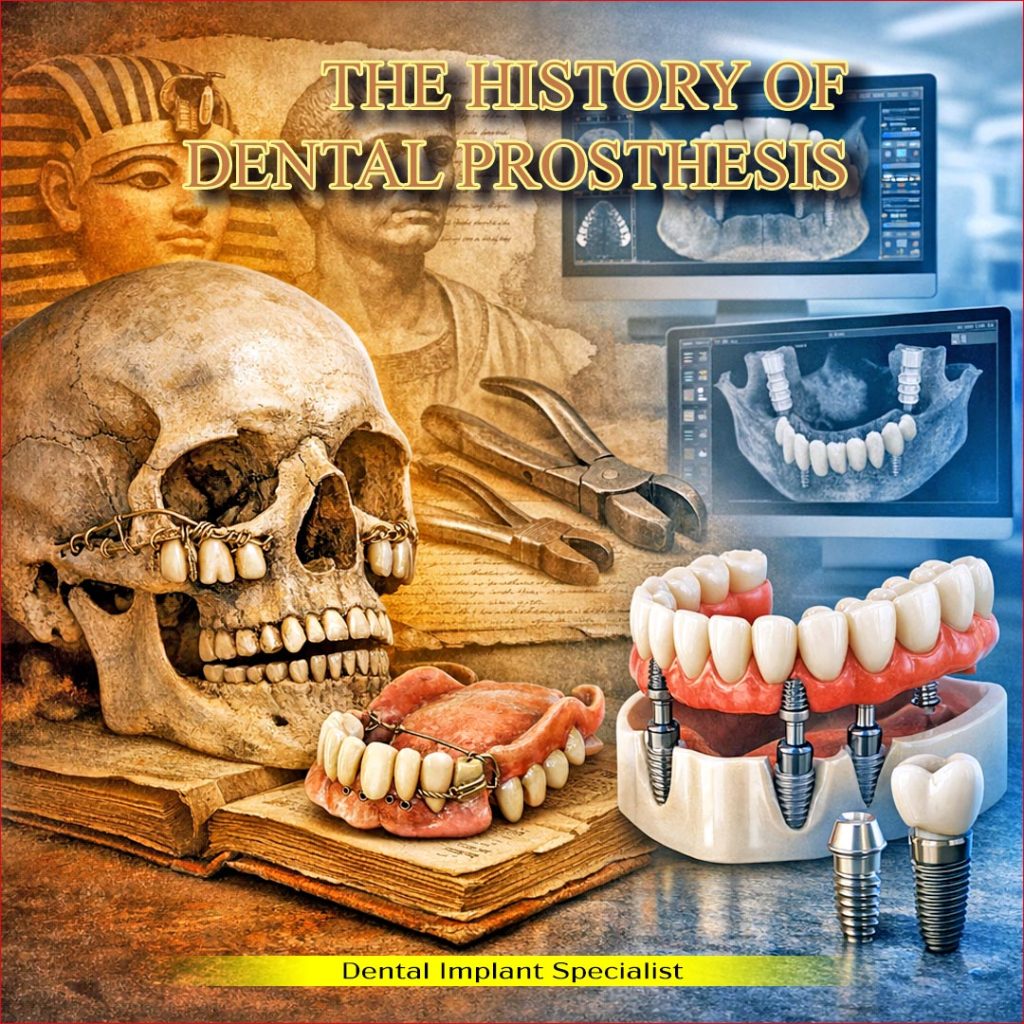
The history of dental prosthesis, from the Etruscans to All-on-4 technology – Dentistry has existed for more than 2000 years
Introduction
The history of dental prosthetics spans more than two thousand years, reflecting the evolution of medicine, technology, and human ingenuity. From the ancient Etruscan gold‑wire restorations to today’s digitally planned All‑on‑4 solutions, the journey has been long and transformative. Throughout history, replacing missing teeth has always been essential — not only for chewing and speaking, but also for overall quality of life. This article explores the most important milestones in dental prosthetics and shows how early attempts gradually led to the precise implant‑based systems used today.
ANCIENT BEGINNINGS – ETRUSCANS, EGYPT, ROME
Etruscan craftsmanship – the first true dental prosthetics
The Etruscans are among the most significant contributors to the early history of dental prosthetics. As early as several centuries BCE, they created restorations in which missing teeth were replaced and secured with finely crafted gold wires. These prostheses were often made from human or animal teeth and provided surprising stability. Archaeological findings show that Etruscan restorations were not only technical achievements but also aesthetic ones. In their society, the condition of one’s teeth was closely tied to social status, so these early prostheses served both functional and symbolic purposes.
Egyptian solutions – fibers and early stabilization techniques
Archaeological evidence from ancient Egypt reveals several attempts at stabilizing or replacing teeth. Loosened or missing teeth were tied together using plant fibers or thin cords. Although these methods were not durable, they demonstrate that managing tooth loss was already considered important. Mummified remains show that Egyptians experimented with various techniques, including early forms of bone replacement. While primitive, these attempts mark essential steps in the development of dental care.
Roman innovations – metals and early dental instruments
Roman medicine was highly advanced for its time, and this is reflected in their dental practices. Excavated tools include forceps, drills, and other instruments that later eras would refine. Romans also used metals for dental restorations, and written sources indicate that dental procedures were available to the upper classes. Gold fastenings were common, offering greater durability than earlier methods.
Middle Ages and Renaissance – the era of barber‑surgeons
During the Middle Ages, dentistry declined, and tooth extraction was often performed by barber‑surgeons. Poor hygiene and limited medical knowledge made these procedures risky, with infections posing serious threats. Prostheses of this era were typically made from bone, wood, or animal materials, serving mainly aesthetic purposes. Functional stability was rare, and most prostheses could be worn only for short periods. With the Renaissance came renewed interest in anatomy and medicine. Physicians gained more accurate anatomical knowledge, enabling safer and more precise dental procedures.
18TH–19TH CENTURIES – THE BIRTH OF MODERN DENTISTRY
The arrival of porcelain teeth
In the late 18th century, Alexis Duchâteau created the first porcelain teeth. These were more durable and aesthetically pleasing than earlier materials. Porcelain marked a turning point, making it possible to produce prostheses that looked natural while functioning reliably.
George Washington and the myth of the “wooden teeth”
Although widely believed, George Washington did not wear wooden dentures. His prostheses were made from ivory, gold, and other materials. While far from comfortable, they represent an important milestone, illustrating the complexity of treating tooth loss even in the 18th century.
The vulcanite era – prosthetics become accessible
By the mid‑19th century, vulcanite emerged as a low‑cost, easily moldable material. This made dentures accessible to a much broader population. The vulcanite era democratized dental prosthetics and laid the foundation for modern dental technology.
THE 20TH CENTURY – TITANIUM AND THE RISE OF IMPLANTS
The discovery of titanium and biocompatibility
In the mid‑20th century, researchers discovered that titanium integrates exceptionally well with bone. The phenomenon of osseointegration — the stable connection between bone and implant — was scientifically confirmed, revolutionizing dental prosthetics. This breakthrough made long‑term, stable implant‑based solutions possible.
The emergence of two‑stage implants
Traditional implant protocols involved two phases: placing the implant, followed by a healing period before attaching the abutment and prosthesis. This method provided predictable results but required a longer treatment timeline. For decades, two‑stage implants formed the foundation of implant dentistry.
The development of one‑stage implants
With the rise of minimally invasive techniques, one‑stage implants became increasingly popular. They offer faster healing, reduced tissue trauma, and shorter treatment times. Modern one‑stage systems provide strong primary stability and are often immediately loadable. Their key advantages include: — placement in a single phase, — immediate loading, — bone grafting often unnecessary, — typically completed within one week, — stable, aesthetic results.
THE 21ST CENTURY – ALL‑ON‑4 AND FULL‑ARCH REHABILITATION
Why a new solution was needed
For patients with severe bone loss, traditional implant placement often required bone grafting — a lengthy and costly process. Modern dentistry sought a faster, safer, and more predictable solution with fewer surgical steps.
The essence of the All‑on‑4 concept
The All‑on‑4 method uses four strategically positioned implants to support a full set of teeth. Its advantages include: — immediate loading, — bone grafting often unnecessary, — short treatment time, — stable, aesthetic results. This approach is especially beneficial for patients who have struggled with tooth loss or bone resorption for many years.
The role of digital dentistry
CBCT imaging, 3D planning, and precision‑guided surgical protocols enable fast, predictable, and safe procedures. Digital technology now supports every step of the process — from diagnosis to the fabrication of the final prosthesis.
Summary
The history of dental prosthetics reflects human creativity and the continuous advancement of medical science. From Etruscan gold‑wire restorations to modern All‑on‑4 technology, the evolution has made dental care more effective, safer, and more accessible. Today’s patients benefit from solutions that would have been unimaginable only a few decades ago — fast, predictable, and long‑lasting.
Blog rovatunkban számos írás olvasható fogpótlás implantátummal, fogbeültetés egyfázisú és kétfázisú implantátummal, valamint All-On-4 és All-On-6 technológiával témakörben.
A legmodernebb eszközökkel és anyagokkal dolgozunk, több mint 30 éves tapasztalattal, 35 000 sikeres implantátum beültetéssel és 99.7 % os sikeraránnyal. Kérdéseidre választ kaphatsz a Fogpótlás Implantátummal | Dental Implants Facebook csoportunkban.
iliDent Páciens Koordinátor © Copyright 2026
iliDent.hu