

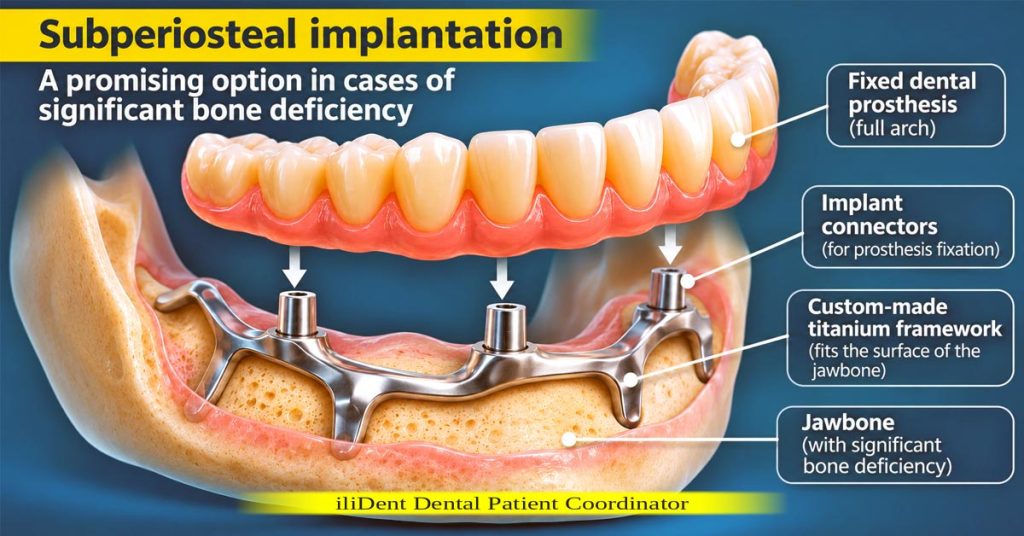
Subperiosteal Implantation: A New Option for Severe Jawbone Loss
Introduction
Subperiosteal implantation can offer a promising option for patients with significant jawbone loss. Losing teeth can affect more than just chewing and everyday activities. Over time, tooth loss may also lead to changes in the jawbone and a reduction in bone volume. This can become a major challenge when a patient wants stable, implant-supported teeth but no longer has enough bone, or the bone is not of sufficient quality, to securely support conventional dental implants.
In these situations, patients do not necessarily have to give up on the possibility of implant-based oral rehabilitation. Modern dental technologies now include personalized solutions that can provide additional options in cases of significant bone loss. One of these is subperiosteal implantation. Unlike conventional implants, which are placed directly into the jawbone, this approach uses a custom-designed titanium framework that fits over the surface of the jawbone.
But what does this mean in practice? Who may be a candidate for this treatment? How does the titanium framework connect to the final dental prosthesis, and what factors need to be considered before treatment? This article provides a clear, easy-to-understand overview of these questions.
Why Is Severe Jawbone Loss Such a Challenge?
Conventional dental implants are placed into the bone of the jaw. Successful placement and long-term function require sufficient bone volume and adequate bone quality. When the jawbone has deteriorated significantly, implant placement may become more difficult or may not be possible using conventional techniques under the existing anatomical conditions.
Bone loss can have several causes. After teeth are lost, the way forces are distributed across the affected area changes, and the bone may gradually decrease in volume. Previous inflammatory conditions, periodontal disease, injuries, and earlier surgical procedures can also affect the condition of the jawbone.
The extent and location of bone loss vary from patient to patient. In some cases, significant bone deficiency affects only a limited area. In others, a larger portion of the jawbone is involved. The anatomical structures of the upper and lower jaws are also different, so the same treatment approach cannot automatically be applied to both.
Patients often become aware of the problem when they inquire about implant-supported teeth and diagnostic examinations reveal that there is not enough suitable bone for conventional implant placement. However, this does not automatically mean that every implant-based treatment option is ruled out.
What Treatment Options Are Available for Significant Jawbone Loss?
Treatment options must always be tailored to the individual patient. The extent of bone loss, anatomical conditions, general health, and the type of dental prosthesis required all influence which procedures may be considered.
In some cases, bone grafting procedures can create the conditions needed for conventional implant placement. The purpose of bone grafting is to provide a more suitable bone foundation for the implants. The type and extent of the procedure depend on the individual situation. In certain cases, this may involve more complex treatment, a longer healing period, and several consecutive surgical procedures.
In other cases, conventional implant techniques adapted to the available bone may also be considered. However, the decision is not based solely on the number or type of implants. Implant positioning, the load placed on the planned prosthesis, and the expected outcome of the complete rehabilitation must also be taken into account.
For patients with significant bone loss, subperiosteal implantation may be considered as an individual treatment option. Its defining feature is a custom-designed titanium framework shaped to fit the surface of the patient’s jawbone. In appropriately selected cases, this approach may offer an alternative when conventional implants placed into the bone are not feasible or would require extensive bone grafting.
It is important to understand that no single procedure is universally better in every situation. The advantages, limitations, and risks of each option must be carefully evaluated when selecting the appropriate treatment.
What Is Subperiosteal Implantation?
The procedure is based on a custom-made titanium implant framework. The framework is designed to match the individual anatomical shape of the patient’s jawbone and is placed on the surface of the bone, beneath the periosteum. Depending on the design of the system used, specialized implant components are connected to the framework to provide the foundation for securing the dental prosthesis.
The main difference from conventional implant treatment is the way the framework is supported. Instead of relying on implants placed directly into the jawbone, this method uses a personalized titanium framework that follows the shape of the bone surface. Components connected to the framework provide the basis for attaching the planned dental prosthesis.
The framework is individually designed. Every patient’s jawbone shape, anatomical structures, and dental restoration needs are different. For this reason, the planning process takes into account both data obtained from individual diagnostic imaging and the specialist’s clinical assessment.
The significance of this technology is that it may make implant-supported teeth an option for patients whose jawbone loss prevents the use of conventional dental implants.
How Does the Custom Titanium Framework Connect to the Dental Prosthesis?
The custom titanium framework and the dental prosthesis are not two independent components. Surgical and prosthetic considerations must be coordinated throughout the planning process. It is not enough to design a framework that fits the jawbone. The way the connected implant components will support and secure the dental prosthesis must also be planned.
Several factors influence the design of the prosthesis:
— The anatomical shape of the jawbone and the available space,
— The number and position of the teeth being replaced,
— The requirements for restoring chewing function,
— The structure and material of the planned dental prosthesis,
— The requirements for effective cleaning and long-term maintenance.
The anatomical structures of the upper and lower jaws differ, so the titanium framework and the dental prosthesis require individual planning in every case. The goal is to create a rehabilitation system in which the surgical support and the dental prosthesis function as a properly coordinated unit.
Subperiosteal implantation is therefore more than simply placing a specialized titanium framework. The framework, its connected implant components, and the dental prosthesis must all be designed to work together throughout the treatment process.
How Is the Treatment Performed?
The treatment may involve several consecutive stages. The exact process depends on the individual treatment plan, the system being used, and the patient’s anatomical characteristics.
First step: Initial Assessment and Specialist Examination
The first step is a detailed examination of the oral cavity, jawbone, and available prosthetic treatment options. The implant specialist assesses the extent of bone loss, the anatomical structures, the condition of the soft tissues, and general health factors that may affect the safety of the procedure and the expected outcome.
Based on the examination results, the specialist can determine which treatment options may be appropriate for the patient. The goal is not simply to establish whether an implant procedure can be performed, but also to determine how the dental prosthesis can be properly planned.
Second step: Digital Planning and Custom Manufacturing
Anatomical data obtained from appropriate diagnostic imaging can be used to create a digital design of the titanium framework tailored to the patient’s jawbone. The planning process takes into account the shape of the bone surface, the location of anatomical structures, and the requirements for securing the planned dental prosthesis.
The custom framework is manufactured according to the approved design. Its personalized shape is intended to match the patient’s anatomical characteristics and provide a suitable foundation for the planned dental prosthesis.
Third step: Surgical Procedure
During surgery, the custom-designed titanium framework is placed on the surface of the jawbone, beneath the periosteum. The method of fixation depends on the system being used and the patient’s individual anatomical conditions. Specialized implant components connected to the framework may then be placed.
Fourth step: Completion and Placement of the Final Dental Prosthesis
Following the surgical stage, the planned dental prosthesis is completed or finalized in accordance with the prescribed treatment and healing stages. The goal is to replace the missing teeth and restore chewing function with a fixed dental prosthesis.
After the prosthesis has been delivered, it remains important to attend the follow-up appointments scheduled by the treating specialist and maintain proper oral hygiene at home.
What Are the Potential Advantages of This Method?
One important feature of the personalized design is that the titanium framework is not a standard, prefabricated component. Instead, it is designed around the individual anatomical characteristics of the patient’s jawbone.
Potential advantages of the method include:
— Custom-designed framework: The shape of the titanium framework is adapted to the anatomical structure of the patient’s jawbone.
— An alternative treatment option for significant bone loss: In appropriately selected patients, it may make implant-supported teeth possible even when conventional implant placement is not feasible.
— The possibility of avoiding extensive bone grafting: In certain cases, the method may provide an alternative to the extensive bone grafting procedures that would otherwise be required for conventional implant treatment.
— Digital planning and custom manufacturing: Data obtained from diagnostic imaging helps guide the design of a framework tailored to the patient’s individual anatomical characteristics.
These potential advantages do not guarantee the same benefits or outcomes for every patient. The expected result depends on the patient’s condition, treatment planning, surgical execution, prosthetic design, and follow-up care.
Who May Be a Candidate for Subperiosteal Implantation?
This method may be considered primarily for patients with significant jawbone loss that makes conventional dental implant placement impossible or would require extensive bone grafting. It may also be considered for patients who no longer have teeth suitable for prosthetic restoration and require a full-arch fixed dental prosthesis.
However, the suitability of subperiosteal implantation cannot be determined solely by the amount or quality of the available bone. The specialist must also evaluate the patient’s general health, the condition of the oral cavity and soft tissues, the ability to maintain good oral hygiene, the desired prosthetic outcome, and other available treatment options.
The method is not suitable for every case of severe jawbone loss, and it should not automatically be regarded as a replacement for conventional implants or bone grafting. Selecting the appropriate treatment requires a detailed specialist examination and an individualized treatment plan.
What Are the Risks and Limitations?
Subperiosteal implantation is a complex surgical and prosthetic procedure. Along with its potential advantages, it also involves risks and limitations. These must be considered during treatment planning, just as carefully as the patient’s individual characteristics and the expected outcome.
Potential complications may include:
— Wound-healing problems: For example, wound separation or delayed healing.
— Soft tissue inflammation and infection: The tissues surrounding the titanium framework may become inflamed. Pain or discharge may also occur in some cases.
— Partial exposure of the titanium framework: Retraction of the overlying soft tissues or problems with wound healing may cause part of the framework to become visible.
— Mechanical or prosthetic complications: The fixation may loosen, or individual components of the dental prosthesis may become damaged.
The frequency and severity of potential complications may depend on the system used, the patient’s condition, and the circumstances of the treatment.
Long-term maintenance depends particularly on appropriate patient selection, careful planning, proper surgical and prosthetic execution, the cleanability of the dental prosthesis, and regular follow-up examinations. The treating specialist should provide personalized instructions for home oral care and the recommended frequency of follow-up visits.
The Importance of a Comprehensive Oral Rehabilitation Plan.
In cases of significant jawbone loss, it is not enough to consider only which type of implant can be placed. The entire dental rehabilitation plan must be evaluated: which teeth need to be replaced, how chewing function can be restored, what forces the final prosthesis will be exposed to, and how effective cleaning can be maintained.
Rehabilitating the upper and lower jaws may involve different anatomical and prosthetic challenges. In some cases, only one jaw is affected. In others, complete restoration of both jaws is required. The scope and structure of treatment are always determined by the patient’s individual condition.
Successful rehabilitation requires coordinated surgical and dental laboratory planning. An appropriate dental prosthesis does more than replace missing teeth. It must also take into account chewing function, stability, comfort, and long-term maintenance.
Frequently Asked Questions
How is subperiosteal implantation different from conventional dental implants?
Conventional dental implants are placed directly into the jawbone. In subperiosteal implantation, a custom-designed titanium framework is placed on the surface of the jawbone, beneath the periosteum. Specialized implant components connected to the framework provide the foundation for securing the dental prosthesis.
Who may benefit from this treatment?
The method may be considered primarily for patients with significant jawbone loss that makes conventional implant placement impossible or would require extensive bone grafting. Suitability must always be determined through an individual specialist examination.
Can bone grafting always be avoided?
No. In appropriately selected cases, this method may provide an opportunity to avoid extensive bone grafting procedures. However, this cannot be guaranteed for every patient. The appropriate treatment must be determined according to the anatomical conditions and the individual treatment plan.
Why is a custom titanium framework made for each patient?
The shape of the jawbone and its anatomical structures vary from person to person. Digital planning allows the titanium framework to be designed around these individual characteristics so that it can provide an appropriate foundation for securing the planned dental prosthesis.
What type of dental prosthesis can be made?
The goal of treatment is to provide a fixed dental prosthesis secured to specialized implant components. The type, material, and structure of the prosthesis depend on the patient’s anatomical characteristics, restoration goals, and individual treatment plan.
Can the method be used in both the upper and lower jaws?
The treatment may be considered for different areas of the jawbone and for more extensive rehabilitation procedures. Its suitability in each case depends on the anatomical characteristics of the affected jaw and the results of the specialist examination.
What risks may be associated with the treatment?
Potential risks include wound-healing problems, soft tissue inflammation, infection, partial exposure of the titanium framework, and mechanical or technical problems involving the dental prosthesis. The treating specialist can provide detailed information about the individual risks.
How long do the results last?
Long-term outcomes are influenced by several factors, including the patient’s condition, the quality of planning and treatment, how easily the dental prosthesis can be cleaned, and regular follow-up examinations. No universal guarantee can be given regarding the lifespan or success of the treatment.
How should a fixed dental prosthesis be cleaned?
The appropriate cleaning method depends on the design of the dental prosthesis and how easily its individual areas can be accessed. The treating specialist should provide personalized instructions on the appropriate oral hygiene tools and techniques.
How often are follow-up appointments needed?
The treating specialist determines the frequency of follow-up appointments based on the patient’s condition, healing progress, and the condition of the tissues surrounding the dental prosthesis. Regular monitoring is an important part of long-term maintenance.
How can I find out whether this treatment is right for me?
A detailed specialist examination and an individualized treatment plan are required. The specialist evaluates the anatomical characteristics of the jawbone, the condition of the bone, general health, oral health, and the patient’s dental restoration goals. Based on these factors, the specialist can determine whether this method is an appropriate option or whether another treatment approach is recommended.
Summary
Subperiosteal implantation is a potential dental restoration option for patients with significant jawbone loss. Severe jawbone deficiency does not necessarily mean that a patient has to give up on the possibility of fixed, implant-supported teeth. A custom titanium framework used in subperiosteal implantation may offer an alternative in selected cases when conventional implant placement is not feasible or would require extensive bone grafting.
However, selecting the appropriate treatment always requires an individual specialist examination, careful planning, and an evaluation of the potential benefits and risks. The goal is not to choose a procedure that can be recommended universally, but to develop an oral rehabilitation plan that matches the patient’s anatomical characteristics and dental restoration needs.
If significant jawbone loss has previously made it difficult to find a suitable implant treatment option, it may be worth learning more about subperiosteal implantation. iliDent Dental Patient Coordinator helps patients take the next steps toward a specialist consultation and coordinates the treatment process.
In our Articles, you’ll find a wealth of valuable information on implant-supported tooth replacement, one-piece and two-piece implant systems, All-on-4 and All-on-6 full-arch restorations, and subperiosteal implant treatment. Our team combines more than 30 years of experience with state-of-the-art technology and materials, over 35,000 successful implant placements, and a 99.7% success rate. If you have questions, you’re welcome to join our Dental Implants Facebook community, where you can find additional guidance and support.
iliDent Dental Patient Coordinator © Copyright 2026
iliDent.com