

Subperiosteal Implants: An Advanced Option for Severe Jawbone Loss
Introduction
Losing teeth can have a significant negative impact on a person’s life for many reasons. However, when teeth have been missing for an extended period and the jawbone has deteriorated considerably, replacing them can become an even more complex challenge.
Conventional dental implant placement requires an adequate amount and quality of bone. When the available bone is insufficient, a bone grafting procedure may be necessary before implants can be placed. But what happens when even bone grafting cannot provide a suitable solution? Are dental implants for severe bone loss still possible?
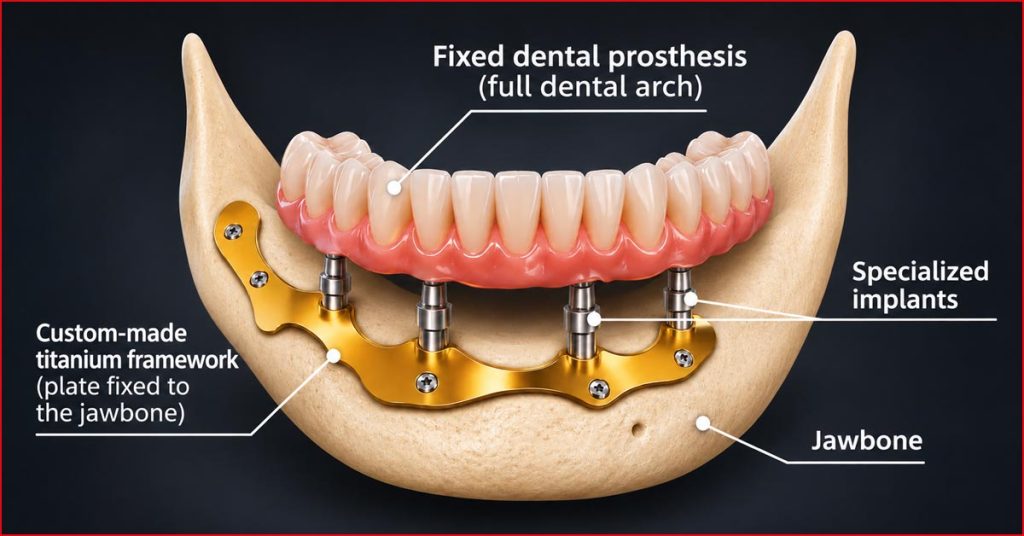
This article explains an alternative approach: subperiosteal implant technology, a personalized treatment option designed for patients with significant jawbone loss. Instead of placing conventional implants directly into the jawbone, this method uses a custom-made titanium framework secured to the surface of the jawbone.. The framework provides a stable foundation for specially designed implants, which then support the fixed dental prosthesis.
Why Does Severe Jawbone Loss Make Dental Implant Treatment Difficult?
The jawbone is not a static structure. After teeth are lost, the bone in the affected area can gradually deteriorate over time. The extent of this change varies from person to person and depends on several factors. These may include how long the teeth have been missing, previous dental and oral surgery procedures, and the individual’s anatomical characteristics. All of these factors can influence how much bone remains available.
Conventional dental implants are placed into the jawbone. To achieve adequate stability, there must be sufficient bone volume and suitable bone quality. If these conditions are not met, conventional implant placement may not be possible.
Severe bone loss can be an especially significant challenge when an entire set of teeth needs to be replaced. In such cases, treatment planning must take into account not only the missing teeth but also the condition of the entire jawbone and the individual characteristics of the oral cavity.
What Is Subperiosteal Implant Technology?
Subperiosteal implantation is a treatment method that differs fundamentally from conventional dental implant placement. It is based on a highly customized titanium framework, digitally designed and individually manufactured to fit the patient’s jawbone..The framework is positioned on the surface of the jawbone and fits precisely beneath the periosteum. It serves as a secure anchoring structure to which specially designed implants are attached.
Subperiosteal treatment is therefore not simply another type of conventional implant-supported tooth replacement. It is a specialized technology based on a different principle of fixation. Its application requires specific professional expertise, specialized dental laboratory technology, and appropriate technical equipment.
When Is Subperiosteal Implant Treatment Recommended?
This technology is a specialized option for dental implants for severe bone loss, particularly when the quantity and quality of the remaining bone are not suitable for conventional implant placement. The treatment plan is prepared by the implantologist who performs the surgery. It is based on a comprehensive examination of the oral cavity, a 3D CBCT scan, and an assessment of the patient’s general health.
The extent of the rehabilitation is determined individually. Depending on the patient’s condition and treatment plan, subperiosteal implant treatment may involve:
— The upper-left quadrant of the jaw.
— The upper-right quadrant of the jaw.
— The lower-left quadrant of the jaw.
— The lower-right quadrant of the jaw.
— The entire upper jaw.
— The entire lower jaw.
— Both the entire upper and lower jaws.
Treatment of the Entire Upper or Lower Jaw
Treatment may extend across the entire upper jaw or the entire lower jaw. In these cases, the objective is to restore the full set of teeth in the affected jaw using a dental prosthesis supported by a custom-made titanium framework.
Treatment of Both the Upper and Lower Jaws
If both jaws are affected by extensive tooth loss, rehabilitation may cover the entire upper and lower jaws. This requires a comprehensive treatment plan for full-mouth rehabilitation, tailored to the patient’s individual condition.
Dental Implants for Severe Bone Loss: Oral Rehabilitation Without Bone Grafting
Many people with significant jawbone loss are concerned that replacing their teeth will require lengthy and expensive bone grafting procedures before implant treatment can begin. One of the important characteristics of subperiosteal implant technology is that it uses specially designed implants. Unlike conventional implants, these are not placed directly into the jawbone. Instead, they are attached to a custom-made titanium framework secured to the surface of the jawbone.
According to the implantologist, this method makes lengthy and complex bone grafting procedures unnecessary in the overwhelming majority of cases. This is an important consideration for patients who have been told that their remaining bone may not be suitable for conventional implant placement. Subperiosteal technology offers a different approach to implant-supported oral rehabilitation, even in cases of severe bone loss.
How Is the Custom-Made Titanium Framework Manufactured?
The individually designed titanium framework is one of the defining components of subperiosteal implant treatment. Because the framework must fit the surface of the individual patient’s jawbone, its production requires specialized digital planning and manufacturing technology.
The framework is designed using CAD-based planning and produced through a manufacturing process based on digital data. Its dimensions and shape are determined by the patient’s individual anatomical characteristics rather than selected from standard implant sizes.
The titanium components required for this technology are manufactured by a Hungarian company specializing in this particular field.
These details illustrate why subperiosteal implant treatment is not a simple dental procedure consisting of a single intervention. Achieving the planned result requires coordinated professional and technical work, from the patient’s examination and treatment planning to the production of the custom framework and the fabrication of the dental prosthesis.
What Type of Dental Prosthesis Is Used with Subperiosteal Implants?
The titanium framework is securely fixed to the jawbone. Its purpose is to provide a stable foundation for the specially designed implants, which in turn support the fixed dental prosthesis.
The system can be summarized simply:
Titanium framework (anchoring structure) → Specially designed implants → Fixed dental prosthesis
When planning the prosthesis, several factors must be considered, including the area of the jaw being treated, the number of teeth to be replaced, the patient’s bite, and their individual anatomical characteristics. In partial rehabilitation, the prosthesis restores the missing teeth in the treated area. In full-jaw rehabilitation, the objective is to replace the teeth in the entire upper jaw, the entire lower jaw, or, when necessary, both jaws.
The exact design of the oral rehabilitation is determined as part of the treatment plan. The final decision is made after examining the patient and evaluating their individual needs.
How Does Subperiosteal Implant Treatment Differ from Conventional Implantation?
The most important difference between the two technologies is how the implants are anchored.
With conventional dental implant treatment, the implants are placed into the jawbone. Adequate bone volume and suitable bone quality are necessary to provide stable support for the implants and the dental prosthesis. When significant bone loss is present, bone grafting may be required.
Subperiosteal implant treatment uses a different approach. Instead of placing conventional implants directly into the jawbone, an individually designed titanium framework is fitted to the surface of the jawbone. This framework provides the necessary stable foundation for the specially designed implants. The two methods are therefore not simply interchangeable alternatives. They are used under different anatomical and professional conditions. The appropriate treatment method is always selected according to the patient’s individual condition and the objectives of the planned rehabilitation.
An essential distinction is that subperiosteal implant technology can provide an option for implant-supported oral rehabilitation even in cases of severe jawbone loss.
Why Are the Right Professional and Technical Resources Important?
Subperiosteal implant treatment is a specialized technology that requires specific professional qualifications, expertise, and equipment. Planning the treatment, designing and manufacturing the custom titanium framework, and producing the dental prosthesis all require close cooperation between several professional fields.
The implantologist performing the procedure must pass a specific examination to qualify to use subperiosteal implant technology. The treatment is carried out in accordance with the applicable European Union regulations and requirements. The digital and technical resources needed to manufacture the titanium components are also an essential part of the process. The custom framework and the final dental prosthesis can only be produced through appropriate professional cooperation.
FREQUENTLY ASKED QUESTIONS ABOUT SUBPERIOSTEAL IMPLANTS FOR SEVERE BONE LOSS
Can subperiosteal implant treatment be used for every patient with significant jawbone loss?
No. Although this technology offers a treatment option for patients with substantial jawbone loss, its suitability must always be determined through an individual professional examination.
Is treatment possible without bone grafting?
In the overwhelming majority of cases, yes. One of the characteristics of subperiosteal implant technology is that it can be used in cases of severe bone loss, including situations where the available bone is no longer suitable for conventional implant placement
Can subperiosteal implants be used in both the upper and lower jaws?
Yes. Treatment may involve the upper jaw, the lower jaw, or both. Rehabilitation can cover one quadrant of a jaw — the upper-left, upper-right, lower-left, or lower-right quadrant — the entire upper or lower jaw, or both the entire upper and lower jaws.
How is this different from conventional dental implants?
Conventional dental implants are placed into the jawbone. With subperiosteal implant treatment, a custom-made titanium framework is positioned on the surface of the jawbone. The required number of specially designed implants is then attached to this framework.
How can I find out whether this technology is suitable for me?
Only an individual examination can determine whether subperiosteal implant treatment is appropriate in your case. This assessment requires a personal consultation, a 3D CBCT scan, and a thorough examination of your oral cavity and general health.
Summary
Significant jawbone loss can make conventional dental implant placement impossible or considerably more difficult. However, this does not automatically mean that implant-supported oral rehabilitation is no longer an option.
Subperiosteal implant technology is a personalized treatment approach that can provide an alternative to conventional implant treatment involving bone grafting, even in cases of severe jawbone loss.
Depending on the patient’s individual condition and treatment plan, rehabilitation may cover one quarter of a jaw, the entire upper or lower jaw, or both jaws.
Contact us to learn more and find out which tooth replacement options may be suitable for your individual situation.
In our Articles, you’ll find a wealth of valuable information on implant-supported tooth replacement, one-piece and two-piece implant systems, All-on-4 and All-on-6 full-arch restorations, and subperiosteal implant treatment. Our team combines more than 30 years of experience with state-of-the-art technology and materials, over 35,000 successful implant placements, and a 99.7% success rate. If you have questions, you’re welcome to join our Fogpótlás Implantátummal | Dental Implants Facebook community, where you can find additional guidance and support.
iliDent Dental Patient Coordinator © Copyright 2026
iliDent.com