
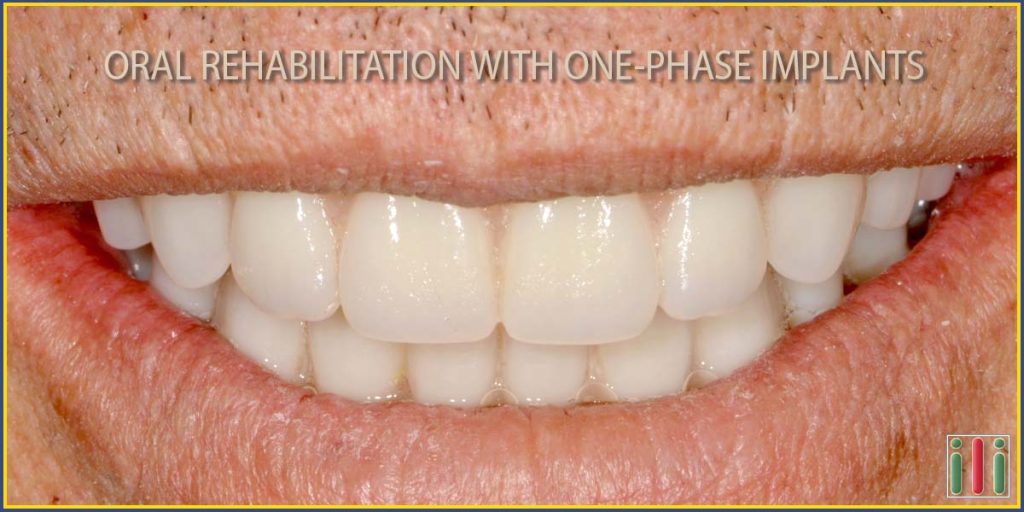
The exact course of oral rehabilitation with one-phase dental implants
Introduction
A healthy, functional set of teeth is essential for overall well‑being, not only for appearance but also for long‑term health. When teeth become damaged, infected, or structurally unsalvageable, replacement becomes necessary. One of the most advanced solutions today is oral rehabilitation with one-phase implant, a treatment method designed for patients who no longer have teeth suitable for long‑term prosthetic care. This first part of the guide explains what oral rehabilitation means, why it is needed, how patients initiate the process, and what happens during the initial consultation and diagnostic phase.
What oral rehabilitation means
Oral rehabilitation becomes necessary when no remaining teeth are suitable for restoration. This may involve the upper jaw, the lower jaw, or both, which is considered full‑mouth rehabilitation. In many cases, teeth are still present, but they are so compromised—due to decay, infection, mobility, or structural damage—that further treatment would only provide a short‑term solution. Saving a tooth is only justified when it can remain functional and healthy for years; otherwise, replacement is the more predictable and cost‑effective option.
Traditional rehabilitation methods rely on removable dentures, which are held in place by suction or adhesive. Although widely used, they often cause problems such as limited chewing power, instability, and discomfort. A more advanced solution is a fixed restoration supported by dental implants. Within implant‑based solutions, two major systems exist: the two‑phase implant and the one‑phase implant. Both can replace the natural tooth root, but the one‑phase system offers unique advantages, especially for patients with bone loss or those seeking faster treatment.
This article focuses on oral rehabilitation with one-phase implant, also known as immediate loading implant treatment. The two‑phase system is mentioned only for comparison.
How patients begin the process
The first step is requesting an appointment with the chosen clinic. Most patients today prefer online appointment requests, which are available 24/7 and allow them to upload X‑rays or describe their dental concerns. Phone calls remain common, although availability varies depending on clinic size and staff. Many modern clinics also accept inquiries through apps such as Facebook, Viber, Messenger, or WhatsApp, which makes communication fast and convenient.
Once contact is established, clinics typically offer a consultation date within a week. At IliDent, the consultation is free, but attending it is the patient’s responsibility. This first meeting is essential, as it lays the foundation for the entire oral rehabilitation with one-phase implant process.
The personal consultation
The consultation is the first clinical step and plays a crucial role in treatment planning. It allows the patient to meet the oral surgeon, ask questions, and build trust—an important factor in any major dental procedure. During this visit, diagnostic imaging is performed, including panoramic X‑ray and cbCT. While the X‑ray provides a two‑dimensional overview, the cbCT scan offers a detailed three‑dimensional image of the jawbone, which is indispensable for implant planning.
Successful implant placement is impossible without accurate imaging. The surgeon must know the bone structure, density, and available space to determine how many implants are needed and where they should be placed. After imaging, a thorough oral examination follows. Implantation can only be performed in a healthy, inflammation‑free oral environment, so any infections or untreated conditions must be addressed first.
The consultation also includes a review of the patient’s general health. The surgeon must know about ongoing medical treatments, medications, allergies, previous anesthesia experiences, and overall well‑being. Once all information is collected, the implantologist explains the available options and recommends the most suitable treatment plan.
If the patient agrees, a written treatment plan and price quote are prepared, valid for three months. At this stage, the clinic also provides information about general anesthesia, which is a standard part of oral rehabilitation with one-phase implant, and explains the required preliminary tests such as bloodwork and EKG.
Consultation with the anesthesiologist
Once the preliminary tests are completed and the consent form is signed, the patient meets the anesthesiologist. During this consultation, the anesthesiologist reviews the patient’s medical history, explains the anesthesia process, and answers questions. If everything is in order, the patient is cleared for surgery.
Removal of teeth unsuitable for treatment
Before implant placement, all teeth that cannot be restored must be removed. In many cases, these teeth are severely damaged, infected, or structurally compromised. Extractions are usually straightforward, although removing roots of dead or broken teeth may require more time. This step ensures a clean, healthy foundation for the implants.
Implant placement
Implant placement is the central part of oral rehabilitation with one-phase implant. Depending on the case, 8–10 one‑phase implants are placed in each jaw. These implants are inserted through the gums directly into the bone, and when necessary, they can be anchored in deeper jawbone regions—an advantage over two‑phase implants, which require sufficient bone volume in specific areas.
Two key advantages of the one‑phase system:
— It can be implanted not only in the tooth‑bearing bone but also in the jawbone when bone deficiency is present.
— The long‑term temporary denture is attached directly to the implants, not to the gums.
After implant placement, a panoramic X‑ray is taken to verify correct positioning. Sutures are removed 5–7 days later.
Long‑term temporary denture
The first stage of rehabilitation concludes with the fabrication and delivery of long‑term temporary dentures. The day after surgery, the patient returns for a check‑up, and additional visits may be scheduled as needed. After 7–10 days, impressions are taken for the metal framework that supports the temporary dentures. These dentures provide function and aesthetics while the implants stabilize.
Permanent denture
The second phase of oral rehabilitation with one-phase implant is the creation of the permanent denture. This usually takes place around six months after implant placement, once the implants have fully stabilized. It may occur later if needed, but it is recommended to complete the final restoration within a year. The permanent denture is not included in the price of the implantation itself. The full process takes about one week and requires three separate appointments.
- The first appointment includes a new X‑ray, removal of the long‑term temporary dentures, and taking impressions for the permanent restoration.
- The second appointment is the framework test, where the underlying structure is checked for accuracy, stability, and comfort before the final teeth are fabricated.
- The third appointment is the fitting of the permanent porcelain denture. If everything fits correctly, the denture is permanently fixed to the implants. It is not removable by the patient.
After the final restoration is completed, the patient receives detailed instructions on oral hygiene, follow‑up visits, and long‑term care.
Why general anesthesia is necessary
Most dental treatments, including implant placement, can be performed under local anesthesia. However, oral rehabilitation with one-phase implant is an exception because it affects the entire oral cavity and requires a long, uninterrupted surgical session. Two main reasons make general anesthesia the recommended approach.
- The entire oral cavity is involved. Full‑mouth rehabilitation affects the upper jaw, the lower jaw, or both. The area is too large for complete and predictable pain control with local anesthesia. General anesthesia ensures total comfort and allows the surgeon to work efficiently.
- The procedure is long. Full‑mouth rehabilitation may take up to four hours or more. Maintaining effective pain control for such a long period is difficult with local anesthesia. General anesthesia provides a stable, controlled environment for both the patient and the surgical team.
The cost of general anesthesia is not included in the implant package price.
What the one-phase implant rehabilitation package includes
The following summary outlines what is included in the package price for oral rehabilitation with one-phase implant. The process is the same whether treatment involves the upper jaw, the lower jaw, or both.
First occasion
— Personal consultation with the implant specialist,
— CT and panoramic X‑ray,
— Comprehensive oral examination,
— General anesthesia,
— Removal of teeth unsuitable for prosthetic treatment,
— Preparation of the required number of one‑phase implants,
— Implantation of the one‑phase implants,
— Impressions for long‑term temporary dentures,
— Fabrication of long‑term temporary dentures fixed on the implants,
— Bonding the dentures, — Necessary control examinations.
Second occasion
— Personal consultation,
— Panoramic and, if needed, CT X‑ray,
— Examination of the oral cavity with special attention to the implants,
— Impressions for the permanent denture,
— Fabrication of permanent porcelain dentures,
— Fixation of the porcelain denture on the implants (not removable by the patient),
— Control examinations and instructions.
Summary
This two‑part guide explained the essential steps and considerations of oral rehabilitation with one-phase implant, a modern and highly effective solution for patients who no longer have teeth suitable for long‑term restoration. The process includes initial consultation, diagnostic imaging, medical evaluation, general anesthesia, removal of compromised teeth, implant placement, long‑term temporary dentures, and finally, the creation of permanent porcelain restorations. Oral rehabilitation with one‑phase implants offers stability, function, and aesthetics, restoring full oral health and confidence. Patients with questions or interest in this treatment are encouraged to contact the clinic for further information.
In our Article section, there are many writings on the following topics: dentures with implants, dental implantation with one-phase and two-phase implants, and
All-On-4 & All-On-6 technology.
We work with state-of-the-art dental tools, materials, and technologies.
30 years of experience, more than 35,000 successful implant placements, and a 99.7% success rate!
iliDent Patient Coordinator © Copyright 2022
iliDent.com