
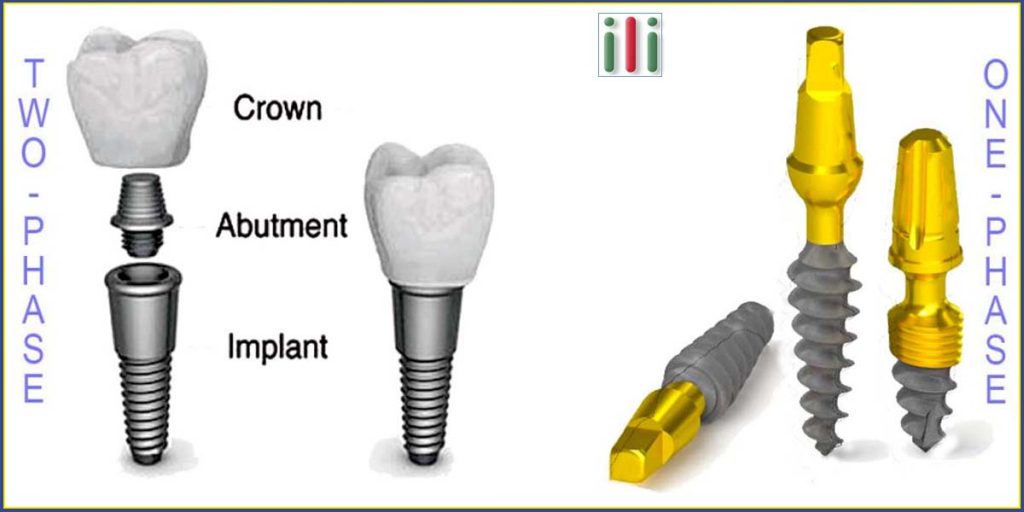
What are the significant differences between a one-phase vs. a two-phase implant?
Introduction
When a patient reaches the point where their natural teeth are no longer suitable for restoration, or complete tooth loss has already occurred, choosing the right implant system becomes a crucial decision. Today, two major implant families are available: the one-phase implant and the two-phase implant. Both are designed to replace the missing natural tooth root, yet their structure, surgical protocol, and clinical usability differ significantly. Understanding the one-phase vs. two-phase implant comparison is essential for anyone considering full oral rehabilitation. This article presents the five most important differences between these implant systems and explains how these differences influence treatment outcomes, comfort, and long-term stability.
About dental implants in general
Dental implants are artificial roots made from high-purity titanium alloys. Their purpose is to integrate with the jawbone through a biological process called osseointegration. Once integrated, they provide a stable foundation for fixed or removable prosthetic restorations. Implants help restore chewing efficiency, improve speech, and maintain facial structure by preventing bone loss.
Before any implant procedure, a thorough diagnostic evaluation is essential. This includes:
– panoramic X-ray – 3D CT scan,
– bone density assessment,
– evaluation of anatomical structures.
Proper diagnostics ensure that the chosen implant system is suitable for the patient’s bone quality and long-term needs.
Two implant families dominate modern dentistry:
– one-phase immediate loading implants,
– two-phase conventional implants
Both systems are effective, but their usability and clinical indications differ substantially.
The 5 Most Important Differences Between One-Phase and Two-Phase Implants
1. Surgical protocol: one-step vs. two-step implantation
The first major difference in the one-phase vs. two-phase implant comparison is the surgical process itself.
One-phase implant
– placed in a single surgical procedure,
– the entire implant (including the abutment portion) is inserted at once,
– typically 2 hours per jaw in full-mouth rehabilitation
– no second surgical intervention is required
Two-phase implant
– requires two separate surgeries,
– first phase: implant base + healing screw + gum closure,
– 4–6 months healing period,
– second phase: gum reopening + healing screw removal + gum shaping,
– temporary removable denture needed during healing.
2. Immediate loading capability
One-phase implant
– designed for immediate loading,
– long-term temporary denture fixed shortly after surgery,
– temporary restoration is non-removable by the patient,
– full chewing function and aesthetics during healing.
Two-phase implant
– cannot be loaded immediately
– implant must remain undisturbed under the gum for months,
– patient must use a removable temporary denture,
– reduced comfort and functionality during healing.
Immediate loading is one of the strongest advantages of one-phase implants.
3. Structural design: single-piece vs. multi-piece system
One-phase implant
– single-piece structure – no healing screw or separate abutment – fewer components → fewer potential failure points – shorter surgical time – reduced risk of bacterial infiltration
Two-phase implant
– multi-component system,
– implant base,
– healing screw,
– abutment,
– gum-shaping screw.
Each additional component increases complexity and surgical steps.
4. Implantation angle flexibility
One-phase implant
– can be inserted at various angles,
– suitable for bone deficiency cases,
– allows anchoring in the densest available bone,
– ideal for elderly patients or long-term denture wearers
– often eliminates the need for bone grafting
Two-phase implant
– must be placed vertically or nearly vertically,
– can only be inserted into tooth-supporting bone,
– limited usability in bone deficiency – bone grafting often required
5. Bone requirements and implant placement options
One-phase implant
– can be placed in tooth bone and jawbone,
– suitable for severe bone deficiency,
– bone grafting often unnecessary
– reduces treatment time and cost
Two-phase implant
– requires high-quality tooth bone,
– insufficient bone → bone grafting or sinus lift,
– complications often arise from inadequate bone assessment.
Summary
The one-phase vs. two-phase implant comparison highlights five essential differences that influence treatment outcomes, comfort, and long-term success. One-phase implants offer immediate loading, angle flexibility, and suitability for patients with bone deficiency, while two-phase implants follow a more traditional, multi-step protocol requiring longer healing times. Both systems have their place in modern dentistry, but understanding their differences helps patients make informed decisions about their oral rehabilitation. For those seeking fast, fixed, and stable results, one-phase implants often provide a more efficient and predictable solution.
In our Article section, there are many writings on the following topics: dentures with implants, dental implantation with one-phase and two-phase implants, and
All-On-4 & All-On-6 technology.
We work with state-of-the-art dental tools, materials, and technologies.
30 years of experience, more than 35,000 successful implant placements, and a 99.7% success rate!
iliDent Patient Coordinator © Copyright 2019
iliDent.com
Pingback: Dentures Fixed on Implants Have Huge Benefits - Get Yours in Just 3 Days
Pingback: One-phase Dental Implants - Full Mouth Restoration in General Anesthesia
Pingback: Implantation Under General Anesthesia Quick and Painless Procedure
Pingback: Implantation under general anesthesia - Contact us for an appointment