

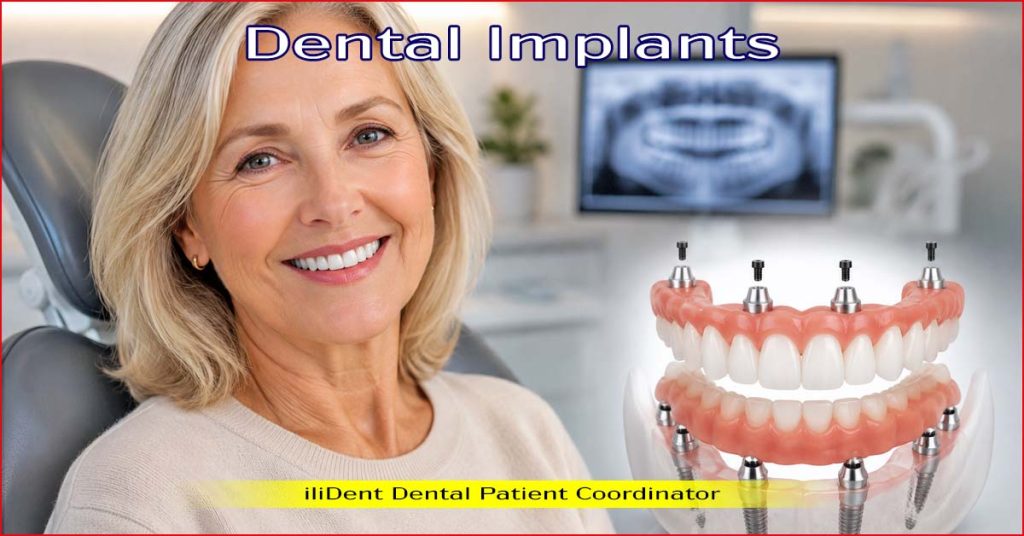
Full-Mouth Rehabilitation with One-Phase Implants – Comfortable Implant Placement Under Anesthesia
Introduction
Losing most or all of your teeth, or having teeth that can no longer be restored, can significantly affect everyday life. Eating, speaking, and appearance can all become more difficult, while the question of how to restore a stable, fixed set of teeth becomes increasingly important. Dental restoration with implants can be performed using several different approaches, so the same treatment is not necessarily appropriate for every patient.
Full-mouth rehabilitation may involve one-phase or two-phase dental implants, as well as All-on-4 or All-on-6 treatment concepts. The appropriate treatment plan depends on the patient’s individual condition and the available clinical options. Treatment may involve the upper jaw, the lower jaw, or both jaws.
When Should You Consider Full-Mouth Rehabilitation?
Full-mouth rehabilitation becomes particularly relevant when many teeth are missing or when the remaining teeth are no longer suitable for further restorative treatment. At that point, the goal is no longer simply to replace individual missing teeth. Instead, the objective is to restore an entire dental arch—or, when necessary, both arches—with a stable, fixed restoration supported by dental implants.
The number of missing teeth alone is not enough to determine which treatment is appropriate. The condition of the jawbone, the remaining teeth, the overall oral condition, and the type of restoration being considered all play an important role. This is why selecting the appropriate treatment requires a personal consultation and the necessary diagnostic imaging.
How Does Full-Mouth Rehabilitation Work with One-Phase Implants?
Full-mouth dental restoration with implants using one-phase implants is a treatment option in which a long-term temporary restoration is placed following implant placement. The process begins with a personal consultation with an oral and maxillofacial implant surgeon, followed by the necessary CT scan and panoramic X-ray, as well as a detailed examination of the oral cavity. Particular attention is paid to the condition of the jawbone, as this can significantly influence the treatment plan.
If some of the remaining teeth are no longer suitable for restorative treatment, their removal may be part of the treatment process. The required number of one-phase implants are then prepared and placed, followed by the fabrication and placement of the long-term temporary restoration. The exact treatment process and number of implants depend on the individual treatment plan.
Full-mouth rehabilitation is a more extensive and complex dental procedure and may take approximately 3–4 hours. It is therefore understandable that some patients may feel anxious about the treatment, particularly if they have had unpleasant dental experiences in the past. We offer the option of having implant treatment performed under anesthesia when requested by the patient, with anesthesia administered and monitored by external anesthesia specialists.
Why Can’t the Final Restoration Be Placed Immediately?
In full-mouth rehabilitation, a long-term temporary restoration is provided in every case. One reason is that the gums may swell after tooth extraction and implant placement and then gradually change shape during the healing process. Under these circumstances, it would not be appropriate to fabricate the final restoration immediately, because its design needs to correspond to the healed condition of the mouth.
Another important factor is osseointegration. Newly placed implants need time to become properly integrated with the surrounding bone. For this reason, the final restoration is fabricated only after the necessary healing period. According to the treatment information provided by iliDent, complete and secure osseointegration generally takes approximately 4–6 months.
The long-term temporary restoration ensures that the patient does not have to remain without teeth during this transition period. Once the implants have become properly integrated and the condition of the mouth allows it, the final restoration can be fabricated. Depending on the treatment option, the final restoration may be made of zirconia or porcelain-fused-to-metal.
What Implant-Supported Treatment Options Are Available?
Dental restoration with implants does not refer to a single treatment technology. Depending on the individual situation, full-mouth rehabilitation may involve one-phase or two-phase implants, All-on-4, or All-on-6. These are different treatment approaches, so the appropriate option should not be selected in advance based solely on general assumptions.
With All-on-4, four implants are placed in each jaw to support a complete dental arch. Treatment may involve only the upper jaw, only the lower jaw, or both jaws. According to the treatment protocol described by iliDent, the process consists of three appointments. The second appointment takes place approximately seven days after the first, followed by the third appointment another 10–12 days later.
All-on-6 follows a similar principle, but six implants are used in each jaw to support the complete restoration. This option can also be used to treat only the upper jaw, only the lower jaw, or both jaws. The treatment process includes preparation and implant placement, follow-up examination and impressions, and placement of the long-term temporary restoration.
Whether one-phase implants, two-phase implants, All-on-4, or All-on-6 is the appropriate option for a particular patient can only be determined after an individual examination. The number of missing teeth is only one consideration. The available bone, the condition of the oral cavity, and the type of restoration being considered must also be taken into account when developing the treatment plan.
What Type of Restoration Can Be Placed on the Implants?
The choice of material for the final restoration is also an important part of treatment planning. The treatment options described by iliDent include zirconia and porcelain-fused-to-metal restorations, each with different characteristics. The appropriate option can be selected during the personal consultation with the dental specialist.
Zirconia restorations are fabricated using modern CAD/CAM technology, while porcelain-fused-to-metal restorations may be made using a nickel-free cobalt-chromium alloy. The advantages and suitability of each material may differ, so the final choice should be based on the individual treatment plan and the patient’s specific circumstances.
What Does Anesthesia Mean for the Treatment?
Anesthesia can be particularly important for patients who experience significant dental anxiety or who prefer to undergo a longer, more complex implant procedure in a more comfortable setting. Full-mouth rehabilitation may take several hours, making the patient’s comfort an important consideration in the overall treatment experience. We offer the option of having implant treatment performed under anesthesia when requested by the patient.
Anesthesia is administered and monitored by external anesthesia specialists. This does not change the fact that the treatment plan must be developed based on an individual assessment of the patient’s condition. Anesthesia is therefore a treatment-comfort option; it does not, by itself, determine which implant treatment is appropriate.
Frequently Asked Questions1
1. Can implant-supported restoration be performed in every case of complete tooth loss? — Implant-supported rehabilitation offers several treatment options, but whether treatment is appropriate must be determined through an individual examination. Bone condition and other anatomical and clinical factors play an important role in developing the treatment plan.
2. Can implants be placed under anesthesia? — Yes. We offer implant treatment under anesthesia, with external anesthesia specialists providing the necessary care and monitoring when requested by the patient.
3. How many implants are needed for a full-mouth restoration? — This depends on the treatment approach. With All-on-4, four implants support the complete dental arch in each jaw; with All-on-6, six implants are used in each jaw. With one-phase or two-phase implant treatment, the required number of implants is determined by the individual treatment plan.
4. When is the final restoration placed? — The timing depends on the treatment method and the individual healing process. In full-mouth rehabilitation, a long-term temporary restoration is placed first. The final restoration can be fabricated after the implants have properly integrated with the bone, which according to the described treatment protocol generally takes approximately 4–6 months.
5. Can only the upper or only the lower jaw be treated? — Yes. Full implant-supported restoration can be performed on the upper jaw, the lower jaw, or both jaws.
What Is the Next Step?
If you are considering a full-mouth restoration supported by dental implants but do not yet know whether one-phase implants, two-phase implants, All-on-4, or All-on-6 may be appropriate for you, the best place to start is with a personal consultation. The necessary examinations can help determine which treatment options may be suitable in your individual case. iliDent offers a free, no-obligation personal consultation.
Summary
Dental restoration with implants can be performed using several different treatment approaches, so the appropriate solution should always be selected based on the patient’s individual circumstances. Full-mouth rehabilitation may involve one-phase or two-phase implants, All-on-4, or All-on-6, and treatment may be performed on the upper jaw, the lower jaw, or both, with a long-term temporary restoration placed before the final restoration to allow the implants time to properly integrate with the surrounding bone. The appropriate treatment plan should therefore begin with an individual assessment rather than a predetermined technology, and if anesthesia is needed or requested by the patient, implant treatment can also be performed under anesthesia with the involvement of external anesthesia specialists. The appropriate approach can be determined during a personal consultation and the necessary diagnostic examinations.
In our Articles section, you’ll find a wide range of articles covering dental restorations with implants, one-stage and two-stage implant treatment, as well as All-on-4 and All-on-6 treatment options.
We use modern equipment and materials, backed by more than 30 years of experience, 35,000 successful implant placements, and a 99.7% success rate. If you have questions, you can find answers in our Dental Implants | Fogpótlás Implantátummal Facebook group.
iliDent Dental Patient Coordinator © Copyright 2026
iliDent.com